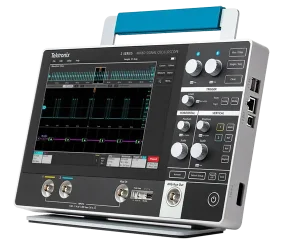
Engineered for high-throughput characterisation, line-condition emulation, dynamic DC-DC conversion profiling, and high-bandwidth signal integrity validation.


A comprehensive examination of how shifting power topologies, electric mobility, and grid decentralization are accelerating global demand for advanced AC & DC source solutions.
Global regulatory bodies require inverters and converters to comply with stringent standards including IEEE 1547, UL 1741, and IEC 61000-4-11. Programmable AC sources must simulate sudden voltage dips, frequency anomalies, harmonically distorted waveforms, and micro-interruptions with negligible output impedance.
The automotive transition from 400V to 800V silicon carbide (SiC) traction architectures mandates DC power sources capable of sourcing and sinking massive currents at operating potentials exceeding 1000V. Bidirectional DC sources are indispensable for testing on-board chargers (OBCs) and motor drives with full regenerative feedback.
AI compute clusters and Open Compute Project (OCP) architectures require high-efficiency 48V-to-1V DC-DC power delivery systems capable of sustaining thousands of amperes. DC power analyzers and precision sources provide sub-microamp current resolution alongside multi-kilowatt dynamic delivery to profile transient load steps.
Analyzing the operational scale, component clustering, and rigorous test automation that position Chinese production centers at the forefront of international instrument exports.
Direct geographic clustering across the Pearl River Delta enables immediate sourcing of planar transformers, wide-bandgap SiC/GaN semiconductors, custom magnetic cores, and high-spec passive filtering networks with minimal transport latency.
Factory floors implement fully automated multi-day burn-in cycling under dynamic thermal and current stress conditions. Every chassis undergoes complete dielectric withstand tests, automated harmonic analysis, and continuous calibration sweeps.
By standardizing 1U/2U/3U high-density power modules, manufacturers achieve exceptional rapid-prototyping turnaround, scaling multi-kilowatt power racks up to megawatt arrays while maintaining short manufacturing cycles.
State-certified metrology labs co-located within export facilities provide internationally recognized calibration documentation aligned with ISO/IEC 17025 standards, validating voltage, current, power factor, and THD tolerances prior to international shipping.
From automated semiconductor foundries to renewable grid interconnection testing, explore how programmable AC/DC sources power key vertical sectors.
| Industry Sector | Primary Power Topologies | Critical Measurement Parameters | Compliance & Quality Mandates |
|---|---|---|---|
| Electric Vehicles & EVSE | Bidirectional Regenerative DC Sources, High-Power AC Simulators | V2G bidirectional loop recovery, dynamic DC fast-charge curves, short-circuit withstand | DIN 70121, ISO 15118, SAE J1772, CHAdeMO compliance |
| Semiconductor & SiC/GaN | Ultra-Low Noise Linear DC Sources, Pulsed Curve Tracers | Dynamic leakage current (pA resolution), gate charge (Qg), reverse recovery transients | JEDEC JC-70, AEC-Q101, wafer-level parametric verification |
| Renewable Solar & Storage | PV Array Simulators, Regenerative Grid Interconnection Sources | MPPT dynamic efficiency, anti-islanding run-away protection, low-voltage ride-through (LVRT) | IEEE 1547.1, EN 50530, UL 1741 SA/SB certification |
| Aerospace & Avionics | 400Hz / 800Hz Variable Frequency AC Power Supplies | Sub-harmonic distortion, rapid frequency ramping, surge and sag recovery, phase unbalance | MIL-STD-704F, DO-160G Section 16, Airbus ABD0100 |
| Consumer Electronics & IoT | Multi-Channel Fast-Transient Programmable DC Supplies | Microamp standby power consumption, load transient spike suppression, ripple rejection | Energy Star tier metrics, IEC 62301 standby compliance |
Technological transformations reshaping programmable power sources over the next decade.
Traditional silicon-based switching stages are being superseded by wide-bandgap semiconductors. This migration triples internal switching frequencies, slashes harmonic output distortion, significantly contracts chassis volume, and enables power densities exceeding 30W/in³.
Modern programmable sources increasingly incorporate ultra-fast digital signal processors (DSPs) and field-programmable gate arrays (FPGAs) to interface seamlessly with HIL simulators (OPAL-RT, RTDS, Typhoon), enabling microsecond real-time simulation of complex power grids.
As corporate carbon neutrality targets tighten, energy-sink testing that dissipates energy as waste heat is obsolete. Next-gen DC electronic loads and AC sources return over 95% of absorbed electrical power back to the local industrial AC distribution grid, substantially lowering test facility HVAC and operating costs.
A structured technical evaluation framework designed for engineering heads, lab directors, and international procurement leaders.
Verify programmable voltage and current slew rates under full rated capacitive, inductive, and dynamic loads to avoid waveform clipping and undershoot during severe test condition transitions.
For precision AC sources, specify linear amplifier output stages or high-frequency filter banks ensuring <0.3% THD under linear loads, preserving pure sinusoidal outputs required for sensitive avionic testing.
Ensure native, high-throughput SCPI command processing across standard interfaces such as LXI-certified LAN, USB-TMC, GPIB, and CAN bus, with native LabVIEW, Python, and MATLAB driver availability.
High-mass programmable power chassis require rugged internal shock isolation, custom seaworthy crating, international freight insurance, and verified multi-year factory warranty coverage.
In-depth technical answers addressing the real-world operational challenges encountered by overseas buyers.
Linear AC power sources utilize analog linear output amplifier stages that yield ultra-low output ripple, imperceptible high-frequency electromagnetic noise, and exceptional total harmonic distortion (<0.1% THD). However, their operational efficiency rarely surpasses 40-50%, resulting in heavy chassis and high heat dissipation. Conversely, switching AC sources leverage PWM inverter topologies operating at dozens to hundreds of kilohertz, delivering up to 90%+ operating efficiency, compact form-factors, and massive power density, making them optimal for industrial grid simulation and large-scale manufacturing test benches.
In burn-in, cycle lifetime, and functional discharge testing of batteries, motor drives, and inverters, traditional unidirectional electronic loads convert incoming electrical energy into waste thermal energy. This demands significant industrial HVAC cooling capacity. Bidirectional regenerative power sources invert incoming DC or AC back onto the factory’s electrical mains at greater than 92-96% efficiency. This direct power recovery slashes total facility electricity consumption and eliminates costly thermal mitigation infrastructure.
Paralleling high-power AC or DC sources requires sophisticated Master-Slave control architectures. Key factors include dedicated high-speed optical or digital bus synchronization to eliminate phase delay, active dynamic current-sharing algorithms that balance thermal distribution across units, and localized autonomous fault isolation that prevents an individual chassis anomaly from causing a cascading system shutdown.
Every precision instrument and power system is calibrated in ISO/IEC 17025 accredited laboratories using transfer standards traceable directly to national metrology bodies (such as NIM, NIST, or NPL). Comprehensive calibration certificates accompany each unit, detailing test uncertainties, environmental temperature conditions, and specific deviation values across full operating voltage and current scales.
Traceable multi-channel instrumentation, waveform analysis, and automated test benches supporting global engineering labs.