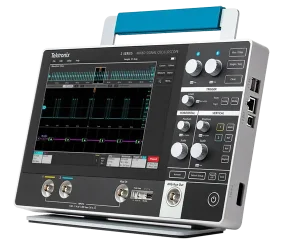
Serial-verified, OEM-original signal synthesizers, ultra-high-bandwidth oscilloscopes, and handheld calibration standards engineered for laboratory R&D and production testing lines.
As high-frequency communication protocols scale toward sub-THz carrier bands, global Tier-1 original equipment manufacturers (OEMs), aerospace prime contractors, and defense laboratories require uncompromised signal fidelity and reliable supply chains.
The contemporary electronic measurement landscape is undergoing seismic shifts driven by the transition from 5G New Radio (NR) to early 6G experimental platforms, Wi-Fi 7 (IEEE 802.11be), satellite constellation telecommunications (LEO megaconstellations), and automotive multi-mode millimeter-wave (mmWave) radar systems (77 GHz to 81 GHz). In this environment, a radio wave generator is no longer an isolated bench instrument; it is the fundamental ground-truth source defining validation integrity.
Global procurement teams operating within multinational semiconductor enterprises, defense consortiums, and automated telecommunications testing facilities encounter substantial logistical and technical barriers: prolonged manufacturer lead times exceeding 40 to 60 weeks, stringent dual-use export compliance protocols, and the continuous challenge of sourcing obsolete or high-specification modular PXIe/AXIe configurations. As an established exporter operating out of Hong Kong, Shenzhen, and Nanchang, Machine-Win bridges this critical supply gap by engineering a dual-advantage procurement ecosystem: factory-original traceability combined with immediate inventory readiness.
Cross-domain application ecosystems require precise radio frequency generation, from direct digital synthesis (DDS) to complex vector baseband IQ modulation and high-energy pulsed arbitrary waveform simulation.
Multi-channel synchronized radio wave generators deliver carrier aggregation, beamforming validation, and error vector magnitude (EVM) analysis down to sub-1% thresholds across Frequency Range 1 (FR1) and Frequency Range 2 (FR2) bands up to 48 GHz.
Recreating dynamic electronic warfare scenarios demands arbitrary waveform generators (AWGs) capable of rendering high-density radar pulse descriptor words (PDWs), agile frequency hopping exceeding 100,000 hops per second, and coherent jamming emulation.
Full-spectrum FMCW chirp generation targeting 24 GHz, 77 GHz, and 79 GHz short- and long-range radar sensors. Accurate testing of target Doppler shifts, multi-target distance profiles, and interference mitigation algorithms under strict ISO 26262 functional safety roadmaps.
Superconducting and trapped-ion quantum computers depend on multi-channel phase-coherent microwave pulses generated with sub-nanosecond skew. AWGs outputting precision XY-control and Z-tuning signals accelerate fault-tolerant quantum algorithm deployment.
High-power continuous wave (CW) and pulsed signal generators controlling solid-state RF energy generators for semiconductor plasma etching, chemical vapor deposition (CVD), hyperthermia therapy, and industrial dielectric heating applications.
Evaluate signal generator topologies to match precise enterprise test tolerances against phase noise, modulation bandwidth, channel count, and spectral purity specifications.
| Architecture Class | Primary Synthesis Topology | Frequency Range Coverage | Spectral Purity (SFDR / Phase Noise) | Target Application Focus |
|---|---|---|---|---|
| Analog CW / Swept Synthesizers | Fractional-N PLL with YIG-tuned oscillators | 9 kHz to 70+ GHz | Phase Noise: < -136 dBc/Hz @ 10 GHz SFDR: > 80 dBc |
LO substitution, radar receiver blocking tests, scalar component validation. |
| Vector Signal Generators (VSG) | Digital I/Q modulation + Wideband baseband DAC | 100 kHz to 44+ GHz | EVM: < 0.4% (5G NR 100MHz) Phase Noise: < -128 dBc/Hz |
Digital telecommunications, Wi-Fi 7, satellite transponder characterization. |
| High-Speed AWG (Arbitrary) | Direct Digital Synthesis (DDS) + High-speed SiGe DACs | DC to 32+ GHz (50 GS/s+) | ENOB: 8 to 14 bits Inter-channel skew: < 5 ps |
Direct RF generation, quantum state manipulation, high-speed optical coherent test. |
| PXIe Modular Multi-Channel | Integrated modular SDR + FPGA backplane | Baseband to 14 GHz | Channel density: Up to 32 coherent ports Phase sync: < 1 deg |
Phased array radar testing, massive MIMO production lines, ATE integration. |
In classical RF design, engineers relied exclusively on analog signal synthesizers coupled to external mixers and I/Q modulators to generate high-frequency radio waves. Modern test workflows, however, favor high-speed Arbitrary Waveform Generators (such as the Keysight AWG70000B series) running at 50 GS/s and beyond. Direct synthesis removes analog I/Q impairments—such as carrier leakage, quadrature phase imbalance, and DC offset—enabling pure computational synthesis directly into microwave frequencies without mixer-induced spur generation.
Conversely, for ultra-low phase noise requirements (such as radar local oscillator testing or Doppler precision benchmarking), high-end Vector Signal Generators utilizing ultra-pure dielectric resonator oscillators (DRO) or optical-comb referenced local oscillators remain irreplaceable. Machine-Win's technical engineering group conducts complete cross-architectural reviews for every procurement mandate to ensure that the chosen platform satisfies both instantaneous modulation bandwidth and spectral purity prerequisites.
Navigating international metrology standards, dual-use customs classifications, and zero-defect logistics guarantees for precision electronic instruments.
Every unit supplied undergoes pre-export verification traceable to NIST, NIM (National Institute of Metrology, China), or DAkkS standards. Calibration data certificates outline verified test points across frequency, amplitude flatness, and harmonic distortion.
High-tier signal generators frequently fall under export control classifications (such as ECCN 3A002.d or 3A002.a). Machine-Win provides export compliance clearance, managing end-user statements (EUS), import licenses, and dual-use documentation.
Precision RF electronics are susceptible to shock, vibration, and electrostatic discharge (ESD). Shipments utilize custom heavy-duty pelican cases or nitrogen-flushed, desiccant-stabilized crating with real-time shock and tilt sensor monitoring throughout transit.
Addressing key engineering and supply chain inquiries regarding radio wave generation instrumentation, lifecycle management, and calibration assurance.
An RF Signal Generator traditionally produces continuous sine waves or standardized analog/vector-modulated signals (AM, FM, PM, QAM) utilizing internal synthesizers optimized for spectral purity and low phase noise. An AWG, by contrast, synthesizes arbitrary voltage points point-by-point via high-speed DACs, allowing the mathematical creation of any arbitrary waveform, wideband pulse, or multi-tone signal directly from software models.
Every unit supplied by Machine-Win arrives in original factory packaging, complete with OEM serial numbers that can be independently verified directly with manufacturers (Keysight, Rohde & Schwarz, Tektronix, Druck). Prior to shipment, high-resolution inspection videos of security seals, firmware screens, and serial plates are shared with the buyer for pre-dispatch validation.
Yes. Many modern signal platforms utilize software-defined licensing for bandwidth expansion, high-stability timebases (OCXO), phase noise enhancements, and modulation codecs (e.g., 5G NR, LTE, Radar Pulse Generation). We coordinate with OEM channels to activate specific feature licenses prior to delivery, ensuring your equipment arrives plug-and-play ready.
Instruments carry full manufacturer warranties or Machine-Win certified warranties depending on the agreed procurement tier. For maintenance, calibration, or servicing, our technical facilities in Shenzhen and Hong Kong manage component-level diagnosis, attenuator/mixer repair, and re-calibration, minimizing cross-border freight downtime.
Expanded laboratory instrumentation catalog comprising multi-domain oscilloscopes, spectrum analyzers up to 67 GHz, Keithley parameter characterization units, and calibrated noise sources.