Original, serial-traceable test modules, oscilloscopes, and multiport analyzers integrated alongside precision DC programmable power supplies for complex lab environments.







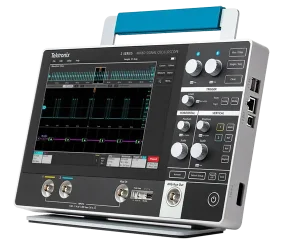
A technical examination of power topologies, bidirectional regenerative energy systems, autoranging capabilities, and critical control loop dynamics for automated test environments.
In modern electronic product design, component qualification, and mass-market automated testing equipment (ATE), the Programmable DC Power Supply has transitioned from an ordinary energy source to an intelligent, precision instrumentation core. Modern programmable power systems are expected not only to feed steady-state direct current with micro-volt resolution, but also to mimic complex electrical anomalies, emulate battery charge-discharge curves, regenerate dynamic energy back onto the public AC grid, and execute arbitrary transient profiles via SCPI (Standard Commands for Programmable Instruments) scripts.
When engineering procurement directors and test systems architects evaluate China programmable DC power supply manufacturers and suppliers, understanding internal topologies is paramount. The industry divides power architectures into three major paradigms: Linear Regulated Topologies, Switch-Mode High-Frequency Topologies (SMPS), and Wide-Bandgap (SiC/GaN) Bidirectional Regenerative Topologies. Each engineering compromise affects ripple voltage (PARD), electromagnetic interference (EMI), slew rate transient dynamics, physical volume, and overall test efficiency.
Characterized by exceptionally low output ripple and noise (down to <350 µVrms), near-zero EMI radiation, and lightning-fast transient load recovery (<50 µs). However, lower conversion efficiency (30%–45%) and heavy toroidal transformers limit their deployment beyond precision analog R&D, medical sensors, and ultra-quiet RF transceiver validation.
Utilizing high-speed PWM switching with compact ferrite cores, modern SMPS units achieve 88%–93% efficiency and broad autoranging envelopes. Advanced multi-stage active power factor correction (PFC >0.98) allows massive power output—up to 15 kW within a compact 3U chassis—ideal for multi-channel burn-in fixtures and industrial motor drive evaluations.
Constructed with dual-active bridge or four-quadrant converter stages using Silicon Carbide (SiC) MOSFETs. These systems function seamlessly as both sourcing DC power supplies and regenerative electronic loads. During continuous battery pack or fuel cell discharge, they return up to 95% of consumed energy back to the local AC mains, mitigating thermal dissipation.
Technical Consideration: Autoranging vs. Rectangular Output Envelopes: Conventional rectangular supplies limit full rated wattage to a single maximum voltage and maximum current coordinate (Pmax = Vmax × Imax). Conversely, advanced autoranging Chinese programmable supplies provide an expansive operating curve, allowing a single 5 kW supply to deliver either 500V/10A or 50V/100A, consolidating bench instrumentation and lowering capital allocation by up to 40%.
Why leading global tier-1 enterprises, ATE system integrators, and international test labs source high-specification programmable DC supplies from Chinese production hubs.
Over the last decade, China has transformed from a low-complexity assembly hub into the global epicenter for power electronic development, wide-bandgap semiconductor packaging, and modular instrumentation manufacturing. Centered around key industrial clusters in the Pearl River Delta (Shenzhen, Dongguan, Guangzhou) and the Yangtze River Delta (Suzhou, Wuxi, Hangzhou), Chinese manufacturers offer unique supply chain advantages that international competitors struggle to replicate.
Local access to advanced planar transformers, nanocrystalline magnetic cores, precision current shunts, and domestic SiC/GaN power modules shortens component procurement lead times from 26 weeks down to under 14 days.
Engineers utilize high-performance digital signal processors (DSPs) and FPGAs to run real-time control algorithms up to 200 kHz. Chinese OEM/ODM engineering teams can develop custom solar I-V curve or battery models in weeks.
High-volume manufacturing driven by the domestic electric vehicle (EV), solar photovoltaic (PV), and energy storage system (ESS) sectors drives down unit assembly costs, offering overseas buyers up to 35%–50% CAPEX savings.
Qualified Chinese manufacturers operate temperature-controlled stress burn-in chambers where every power supply undergoes 72–120 hours of continuous full-load thermal cycling prior to final metrology calibration.
Key electrical performance criteria that multinational quality assurance and procurement teams must evaluate before issuing a purchase order for programmable DC power units.
| Evaluation Parameter | Standard Commercial Grade | High-Precision Industrial Grade | Significance for System Integration |
|---|---|---|---|
| Ripple & Noise (PARD) | < 50 mVrms / 250 mVp-p | < 3 mVrms / 30 mVp-p (or <350 µV on Linear) | Crucial for testing low-noise audio, sensitive micro-controllers, and precision RF power amplifier blocks. |
| Transient Recovery Time | < 2 ms to within 1% of Vout | < 100 µs (Load step 10% to 90%) | Prevents voltage dips or overshoot when dynamic electronic loads cycle rapidly, protecting the DUT from stress. |
| Programming & Readback Accuracy | Voltage: 0.1% + 20 mV Current: 0.2% + 20 mA |
Voltage: 0.02% + 5 mV Current: 0.05% + 2 mA |
Eliminates external digital multimeters (DMMs) in automated test racks, reducing system footprint and complexity. |
| Bus Communication Latency | 15 ms – 50 ms via RS232 / USB | < 1.5 ms via LXI LAN / SCPI over Ethernet | Directly dictates unit test cycle times in high-volume production lines where fractions of a second impact factory throughput. |
| Safety Interlocks & Redundancy | Basic OVP, OCP, OTP software limits | Hardware-latched OVP/OCP, reverse polarity protection, emergency cutoff port | Guarantees human safety and prevents costly laboratory or production line DUT thermal events during unattended testing. |
Beyond electrical specifications, enterprise buyers should ensure the supplier's firmware offers full SCPI compatibility with standard VISA drivers (National Instruments, Keysight VISA). Seamless integration into LabVIEW, Python (PyVISA), C++, and MATLAB test benches saves hundreds of engineering hours when modernizing older automated test stations or developing new test scripts.
Bridging the gap between factory floor manufacturing in China and end-use test laboratories across North America, Europe, Southeast Asia, and Latin America.
Tier-1 Chinese manufacturers build power equipment certified strictly under CE Low Voltage Directive (LVD 2014/35/EU), EMC Directive (2014/30/EU), and UL/CSA 61010-1 safety standards for electrical measurement, control, and laboratory use. Compliance ensures fast customs clearance and immediate operational authorization on client sites.
Every programmable supply shipped comes with comprehensive calibration certificates traceable to the National Institute of Metrology (NIM), NIST, or regional equivalents. Full test reports outline measured voltage, current, and ripple deviations across multi-point operating matrices, fulfilling ISO 9001 quality audit requirements.
Leading partners bridge time-zone gaps through dedicated English-speaking technical teams, video-assisted ATE rack commissioning, and spare module inventory stored in regional logistics hubs across North America and Europe to guarantee rapid RMA handling and parts delivery within 48 to 72 hours.
Furthermore, export-grade packaging incorporates heavy-duty, anti-static moisture barriers, drop-indicator shock tags, and reinforced structural honeycomb crates engineered for air-cargo transport and ocean container freight. This meticulous approach guarantees that sensitive programmable power hardware arrives factory-fresh and ready for immediate deployment.
Delivering high-reliability programmable DC power across mission-critical research benches, automated manufacturing lines, and verification stations.
Equipped with internal resistance programmability (Ri simulation), these supplies emulate multi-cell high-voltage lithium battery packs up to 1500V. They validate DC fast-charging controllers, inverter drive stages, and battery management systems (BMS) with dynamic pulse-current loads.
Integrated EN50530 and Sandia mathematical curve engines allow engineers to simulate complex photovoltaic shadow effects and ambient irradiance changes. They stress-test the maximum power point tracking (MPPT) efficiency of commercial micro-inverters and central PV power conditioners.
Massive multi-channel rack arrays deliver stable low-voltage, ultra-high-current (e.g., 0.8V to 1.2V at up to 1000A) power to high-density server GPUs, AI accelerators, and FPGAs during long-duration High Temperature Operating Life (HTOL) burn-in tests without voltage drift.
Precision transient waveform generators reproduce MIL-STD-704 and DO-160 power-surge and emergency battery switchover conditions. Engineers verify that airborne navigation equipment, radar receivers, and cockpit displays remain stable through sudden bus voltage sag and spike phenomena.
Technological breakthroughs in wide-bandgap semiconductors, digital-twin software modeling, and cloud-connected telemetry shaping the next era of DC power supply engineering.
Replacing traditional silicon IGBTs with Gallium Nitride (GaN) and Silicon Carbide (SiC) semiconductors increases switching frequencies above 150 kHz. This reduces magnetics volume by 45%, improves thermal dissipation, and pushes rack power density to 30 kW in a 3U form factor with >96% efficiency.
Advanced Chinese power supplies feature integrated real-time mathematical models that communicate directly with MATLAB/Simulink and Opal-RT simulators. This allows automotive engineers to test physical electronic control units (ECUs) against virtual battery degradation profiles before physical packs are built.
Modern programmable power instruments now come equipped with native 1000Base-T Ethernet, optical fiber isolation, and integrated REST/MQTT web sockets. Real-time telemetry monitoring tracks internal junction temperatures, fan health, and electrolytic capacitor degradation to predict failures before they happen.
Clear answers to vital technical, compliance, and logistics questions raised by international procurement managers and test systems engineers.
Integrate your programmable DC power infrastructure with high-definition oscilloscopes, pressure calibrators, and RF vector network analyzers to establish a complete turn-key testing laboratory.








