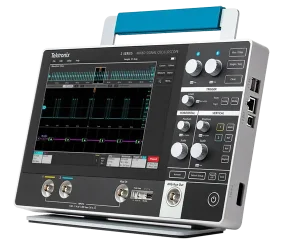
Engineering Whitepaper & Strategic Sourcing Guide: Ultra-Low Noise Programmable DC/AC Power Systems, High-Dynamic Four-Quadrant SMUs, and Worldwide Traceable Export Logistics.
Precision Engineering Solutions
Top-Tier Test, Measurement & Voltage Source Systems
Explore original, manufacturer-traceable instrumentation and programmable signal architectures verified by our senior metrology engineers for mission-critical R&D and production.
Custom Tektronix MSO Mixed Signal Portable Oscilloscope, 2 Series MSO22 MSO24 Manufacturer, Products
The Global Landscape of Precision Variable Voltage Generation
An exhaustive technical examination of variable voltage sources, topology evolution, and international supply chain benchmarks for mission-critical industrial test systems.
99.98%
Voltage Slew Accuracy
< 1 mVrms
Ultra-Low Ripple Density
100+
Global Export Territories
ISO 17025
Traceability Standard
Silicon Carbide (SiC) & GaN Switching Topologies
Modern variable voltage sources have transitioned from bulky, lossy transformer-coupled architectures to high-frequency Wide Bandgap (WBG) semiconductors. By utilizing Gallium Nitride (GaN) and Silicon Carbide (SiC) primary switching stages, contemporary programmable DC and AC voltage sources attain power conversion efficiencies upwards of 95.5%, while switching at frequencies exceeding 200 kHz. This high-frequency switching drastic reduces the required inductor and capacitor volume, enabling high-density power envelopes (up to 15 kW in a standard 3U chassis) while delivering transient slew rates as fast as 150 V/ms.
For modern electric vehicle (EV) drivetrains, battery management systems (BMS), and aerospace actuation systems, a variable voltage source cannot merely source power; it must dynamically act as an electronic load. Modern bi-directional variable DC sources incorporate four-quadrant regenerative circuitry that sinks reverse electromotive force (back-EMF) and returns up to 94% of the kinetic or chemical energy back to the local industrial AC power grid with minimal total harmonic distortion (THD < 3%). This eliminates auxiliary heat dump banks and simplifies factory cooling infrastructures.
4-Quadrant Sinking
94% Grid Feedback
THD < 3%
Sub-Millivolt Linear Regulation & Ripple Rejection
In quantum dot control, semiconductor parametric curve extraction, and ultra-high-frequency RF local oscillator synthesis, switch-mode noise can corrupt measurement channels. The highest-tier variable voltage sources deploy hybrid architectures: a pre-regulated switch-mode stage followed by a precision linear post-regulator. This multi-stage conditioning yields sub-millivolt output ripple (below 500 µVrms across a 20 MHz bandwidth), temperature coefficients under 5 ppm/°C, and transient step recovery times under 20 µs when handling 10% to 90% load dynamic swings.
< 500 µVrms Noise
5 ppm/°C Stability
< 20 µs Step Recovery
Comparative Architecture
Variable Voltage Source Topologies: Industrial Engineering Matrix
A rigorous engineering comparison between primary programmable voltage generator configurations deployed across global validation facilities.
Architecture Type
Typical Voltage & Power Range
Output Ripple / Noise
Dynamic Response Speed
Energy Efficiency
Primary Industrial Use-Cases
Pure Linear Regulated DC
0 - 60 V | Up to 1.5 kW
< 350 µVrms (20 Hz - 20 MHz)
Sub-microsecond (< 5 µs)
40% - 60% (High thermal dissipation)
RFIC biasing, optical transceivers, low-noise analog sensor characterization.
EV battery module/pack cycling, bidirectional DC-DC converter verification, motor dynamometer testing.
Arbitrary Waveform / AC+DC Source
0 - 350 Vrms (AC) / ±500 V (DC)
< 0.3% THD @ 45 - 65 Hz
Slew rates up to 300 V/µs
85% - 90%
DO-160 aerospace surge tests, IEC 61000-4-11 voltage dips and interrupts, smart grid compliance.
Precision Source Measure Unit (SMU)
±1 µV to ±3 kV | pA to 100 A
< 10 µVrms (Sub-pA noise floor)
Programmable damping & integration
60% - 75%
Semiconductor wafer probing, GaN/SiC breakdown characterization, quantum qubit voltage tuning.
Multi-Domain Applications
Localized Engineering Application Scenarios
How global high-tech clusters leverage precision programmable voltage architectures to accelerate qualification cycles and ensure stringent compliance.
With the commercial transition from 400V to 800V silicon carbide traction systems, variable DC voltage supplies serve as hardware-in-the-loop (HIL) battery pack emulators. Testing overvoltage lockouts, high-voltage ripple rejection on On-Board Chargers (OBC), and transient regenerative braking spikes demands sources with zero-overshoot current control and programmable internal series resistance (Ri emulation from 0 to 10 Ω).
Airborne electronic hardware must survive harsh electrical supply transients, including 28 VDC normal surges up to 80V, 115 VAC 400 Hz wild-frequency variations, and lightning-induced voltage spikes. Variable AC/DC programmable sources execute automated arbitrary profiles, injecting microsecond-scale dropouts, DC offset drifts, and harmonic distortion matrices required for RTCA DO-160 Section 16/17 and MIL-STD-704F certification.
Fabrication plants and packaging labs utilize ultra-precise Source Measure Units (SMUs) to characterize gate dielectric leakage, threshold voltage shifts (Vth), and drain current saturation across ultra-wide temperatures. Sourcing nano-volts while measuring femto-amps guarantees early detection of sub-surface lattice defects in advanced 3nm FinFET, GAA (Gate-All-Around), and gallium oxide power transistors.
Femto-Amp Measurement
GAA / FinFET Testing
Wafer Prober Interface
Strategic Horizons
Technology Roadmap: The Future of Variable Voltage Systems
Key technological revolutions shaping the next generation of precision voltage sources between 2025 and 2030.
01
Edge AI Real-Time Compensation
Deployment of on-die neural network inference engines directly within DSP power controllers, compensating for lead inductance and dynamic impedance shifts in real-time under nanosecond loads.
02
Digital Twin Co-Simulation
Direct synchronization between hardware variable voltage sources and MATLAB/Simulink or Python digital twin models, allowing virtual vehicle or satellite systems to stress-test real physical sub-assemblies.
03
Cryogenic & Quantum Biasing
Development of sub-Kelvin compatible low-noise voltage DACs operating near 4 Kelvin with thermal drift figures lower than 0.1 ppm/K, dedicated to flux-qubit gate biasing and spin readout electronics.
04
EtherCAT & TSN ATE Bus
Shift from legacy GPIB/RS-232 to Time-Sensitive Networking (TSN) and Gigabit Ethernet, synchronizing hundreds of distributed variable voltage channels across massive ATE racks with jitter < 50 ns.
Export & Compliance Protocol
Macro-Level Procurement, Global Export & Quality Governance
Why procurement directors and lead test architects in over 100 countries trust Machine-Win as their premier source for mission-critical instruments.
Dual-Use & Export Control Compliance
High-specification precision voltage generators and RF instrumentation frequently fall under international export classifications (such as US EAR, EU Dual-Use Regulations, and Wassenaar Arrangement). Machine-Win operates formal compliance protocols, handling End-User Statements (EUS), dual-use licensing, and automated Harmonized System (HS) classification to ensure customs clearance without port-of-entry impoundment risk.
ECCN Classification
ITAR / Dual-Use Screening
Global Customs Clearing
ISO/IEC 17025 Traceable Calibration
Every variable voltage unit sourced via Machine-Win undergoes rigorous pre-shipment metrology inspection. We furnish ISO/IEC 17025 accredited calibration certificates containing measurement uncertainties traceable to NIST, NIM, or PTB primary voltage standards. This guarantees that internal D/A converters, sense feedback circuitry, and current shunts match factory datasheet tolerances before arrival at your facility.
NIST Traceable
ISO 17025 Certified
Multi-Point Drift Verification
Shock-Mitigated Temperature-Controlled Logistics
High-precision voltage sources contain sensitive ceramic references and mechanical relays vulnerable to transit shock. Our export packaging architecture features bespoke electrostatic discharge (ESD) barriers, desiccant barriers, and drop-tested polyurethane suspension cradles fitted with 3-axis drop/tilt impact indicators. Complete consignment tracking offers full visibility from Hong Kong/Shenzhen logistics hubs to regional test benches.
Tri-Axial Shock Indicators
ESD & Moisture Vacuum Pack
Insured Express Courier
Technical Clarifications
Frequently Asked Questions for Engineering & Sourcing Teams
Comprehensive technical guidance compiled by our test automation consultants to address common procurement and architectural questions.
What is the fundamental difference between a programmable variable voltage source and a Source Measure Unit (SMU)?
While both instruments deliver adjustable voltages, a standard programmable power supply is optimized primarily for power sourcing with typical current measurement resolutions in the milliampere range. An SMU incorporates tightly synchronized four-quadrant operation, functioning seamlessly as a precision voltage source, current source, voltage meter, and current meter with ultra-high sensitivity—often down to 100 nV and 10 fA resolutions. Furthermore, SMUs provide significantly higher loop-bandwidth feedback circuits for semiconductor device testing.
Why is remote 4-wire (Kelvin) sensing essential for high-current variable DC sources?
When high currents flow across lead cables, the intrinsic wire resistance produces an unavoidable IR voltage drop ($V_{drop} = I \times R_{cable}$). In a conventional 2-wire arrangement, the power supply regulates the voltage at its own front output terminals, resulting in a substantially reduced voltage at the device under test (DUT). 4-wire Kelvin sensing routes two dedicated, zero-current high-impedance sense leads directly to the DUT terminals, feeding the actual load voltage back into the supply's error amplifier to ensure zero drop compensation.
How does regenerative power sinking work during battery pack discharge verification?
Conventional electronic loads convert dissipated battery energy entirely into waste heat via internal FET banks, demanding colossal cooling systems. In contrast, a regenerative variable DC source utilizes an active frontend inverter stage. When sinking current from the battery pack, the energy is conditioned through an internal DC link, synchronized with the local 3-phase factory AC mains frequency and phase, and returned to the facility grid with typical efficiencies between 92% and 96%, drastically reducing operational electricity costs.
How does Machine-Win verify hardware condition and serial authenticity for international shipments?
Prior to shipping, our engineers perform a multi-point verification protocol: inspecting factory tamper-evident security labels, reading internal EEPROM hardware serial IDs via diagnostic SCPI queries, cross-checking installed software options and license keys against manufacturer databases, and capturing comprehensive high-resolution photo/video dossiers that are submitted to the procurement client before dispatch.
What criteria should be used when choosing between linear and switch-mode variable voltage sources?
Select a linear architecture when low noise floor (< 1 mVrms ripple), rapid microsecond dynamic transient recovery, and absence of high-frequency radiated switching interference are mandatory (e.g., analog front-ends, audio ICs, VCOs). Select a switch-mode source when high power density, compact rack footprint (e.g., 5 kW to 30 kW per chassis), and high electrical conversion efficiency outweigh strict microvolt noise specifications.
Can Machine-Win accommodate custom automated test rack integration (ATE) requirements?
Yes. Beyond supplying standalone bench units, our applications engineering department assists global system integrators in designing unified ATE racks. We supply compatible rack-mount kits, high-current busbars, interlock safety relays, IVI/LabVIEW/Python SCPI drivers, and multi-channel signal routing matrices to ensure your variable voltage channels synchronize seamlessly with oscilloscopes, VNAs, and DAQ platforms.
Enterprise Hardware Catalog
Integrated Test Benches, Analyzers & Calibration Standards
Complete your instrumentation suite with world-class calibration gear, high-speed waveform generators, and automated test instrumentation.
Best Tektronix MSO Mixed Signal Oscilloscope, 4 Series B MSO44B, MSO46B Supplier, Products