Keysight Pro Vector Network Analyzer NA5202A PNA-X
Premier microwave network analyzer platform for active device characterization, multi-port pulsed-RF, and high-linearity component testing.
View Product Details →Integrate certified LPS source modules and industry-standard measurement instruments for automated validation, EMC compliance, and electrical characterization.

Premier microwave network analyzer platform for active device characterization, multi-port pulsed-RF, and high-linearity component testing.
View Product Details →

Compact RF signal analysis with high sensitivity down to -165 dBm/Hz, ideal for IoT emissions pre-compliance and switched-mode power supply ripple validation.
View Product Details →
Ultra-wide bandwidth signal synthesis delivering complex radar, optical, and high-speed serial stimulus with unmatched SFDR and low phase noise.
View Product Details →
Designed specifically for EMC applications with LAN connectivity, delivering accurate power measurements in demanding radiated susceptibility test chambers.
View Product Details →
Robust field calibrator generating 95% vacuum to 20 bar in seconds with touch-screen operation and integrated electrical loop power verification.
View Product Details →
Four-channel device current waveform profiling from sub-nanoamps up to 100 A with up to 1 GSa/s rate, uncovering LPS power supply dynamic transients.
View Product Details →
High-end VNA featuring hardware-implemented LO generation, exceptional dynamic range (up to 147 dB), and touchscreen-driven complex mixer tests.
View Product Details →
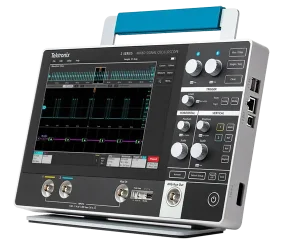
Ultrathin mixed-signal bench scope offering up to 500 MHz bandwidth, 16 digital channels, and battery-powered mobility for power supply field debugging.
View Product Details →A rigorous examination of electrical boundaries, regulatory safety classifications, and current-limiting circuit topologies defined by IEC/EN 62368-1 and IEC 60950-1.
Under international electrical safety standards, a Limited Power Source (LPS) is strictly defined to prevent fire hazards under both normal operation and single-fault conditions. The output energy envelope is restricted to an apparent power of ≤100 VA (or ≤100 W for DC) and an open-circuit voltage of ≤30 VDC (or ≤60 VDC with maximum current capped at 8 A). This allows downstream equipment engineers to relax enclosure flammability ratings to UL 94V-1 or V-2, eliminating costly fire enclosures.
LPS power supplies achieve safety compliance through precision active or passive current-limiting networks. Standard industrial approaches include inherently limited magnetic designs (high-leakage inductance isolation transformers) or electronically regulated limiters using high-side shunt current monitors, foldback limiters, and cycle-by-cycle digital PWM control. These circuits ensure instantaneous shutdown or constant-current latching during downstream short-circuits.
Unlike consumer wall-adapters, wholesale industrial and instrumentation-grade LPS units manufactured by Machine-Win feature low-noise linear post-regulation, active power factor correction (PFC > 0.98), and galvanic isolation up to 4,242 VDC. Designed to power sensitive ATE benches, optical modules, and sensor nodes, they exhibit ripple and noise specifications below 1 mVrms, shielding ultra-fast signal chains from interference.
Specifying LPS-certified power modules in automated test equipment racks substantially reduces system-level certification complexity. Because LPS circuits intrinsically eliminate secondary-side ignition risks, adjacent switching matrices, breakout boards, and device fixtures do not require independent containment testing during UL/CSA and CE Mark site inspections.
| Electrical Safety Standard | Open Circuit Voltage (Uoc) | Maximum Apparent Power (Smax) | Maximum Available Current (Imax) | Overcurrent Protection Requirement |
|---|---|---|---|---|
| IEC 60950-1 / IEC 62368-1 (Inherently Limited) | ≤ 30 VDC | ≤ 100 VA | ≤ 8.0 A | Not required (limited by internal impedance) |
| IEC 62368-1 (Non-Inherently Limited) | 30 VDC < Uoc ≤ 60 VDC | ≤ 100 VA | ≤ 100 / Uoc (e.g., 2.08 A @ 48V) | Current-limiting device mandatory (fuse or PTC) |
| NEC Class 2 Circuit (UL 1310 Standard) | ≤ 30 VDC | ≤ 100 VA | ≤ 5.0 A (Overcurrent device rated ≤ 5.0 A) | Secondary discrete fuse or electronic limiter |
| Precision Instrumentation Grade LPS | 0 – 32 VDC (Programmable) | Programmable limit up to 100 W | 0.001 – 5.000 A (100 µA resolution) | Dual-layer hardware comparator + digital loop |
Deploying specialized LPS power supply units across global manufacturing facilities, semiconductor test houses, cleanrooms, and automated telecommunication hubs.
Smart city arrays, industrial LoRaWAN gateways, and wireless vibration sensor monitors demand low-voltage DC rails immune to grid surge transients. Our LPS power supplies provide clean 12V/24V outputs with continuous hardware energy containment, protecting sensitive RF frontend transceivers and ensuring year-round unattended operation in harsh electromagnetic environments.
Automotive tier-1 suppliers utilize multi-channel LPS units during pre-compliance stress testing for battery management systems (BMS). The sub-100VA per channel safety envelope ensures that simulated cell overvoltages or dead shorts on test fixtures cannot generate thermal runaway, enabling safe 24/7 automated qualification of battery balancing circuits.
Clinical analyzers, blood centrifuges, and in-vitro diagnostics (IVD) incorporate LPS modules alongside IEC 60601-1 Class II power architectures. The 100 VA energy cap acts as an essential firewall, isolating sensitive patient-connected signal paths and precision microfluidic pumps from catastrophic short-circuit failures.
High-density automated storage and retrieval systems (ASRS) and collaborative robotic arms require decentralized control bus supplies. Standardizing on LPS-certified distributed DIN-rail supplies allows electrical panels to meet NFPA 79 safety guidelines without requiring heavy containment conduits for sensor wiring.
Distributed antenna systems (DAS) and 5G small cells rely on LPS power sources to supply Remote Radio Heads (RRHs) over composite fiber-copper cabling. The current-limited output satisfies Class 2 electrical codes, enabling safe cable routing through ceiling plenums without rigid metal shielding.
Inside semiconductor characterization and PCB functional test fixtures, multi-rail LPS units supply bias power to device under test (DUT) interfaces. In the event of a silicon latch-up, the ultra-fast electronic current trip clamps the energy delivered to less than 0.5 Joules, preserving expensive prototype wafers and test sockets.
Examining the convergence of wide-bandgap semiconductors, digital control loops, and predictive telemetry across 2025–2030 power system designs.
The transition from silicon MOSFETs to Gallium Nitride (GaN) high-electron-mobility transistors (HEMTs) allows switching frequencies to climb from traditional 100 kHz thresholds to beyond 2.5 MHz. This shift slashes magnetic core volume by 65%, eliminates bulky electrolytic capacitors in favor of solid ceramic components, and elevates power conversion efficiency above 96.5%, meeting stringent 80 PLUS Titanium and EU Ecodesign standards.
Traditional analog feedback loops rely on optocouplers prone to thermal aging. Next-generation LPS supplies employ high-speed digital signal processors (DSPs) with dual-core ARM Cortex architectures executing 12-bit cycle-by-cycle ADC sampling. These systems calculate instantaneous energy integration (∫ V × I dt) at 100 kHz intervals, providing software-configurable LPS boundary profiles matched to specific regional code exemptions.
Standalone analog power supplies are obsolete in Industry 4.0 production environments. Advanced LPS platforms integrate PMBus v1.3, Modbus-TCP, and real-time deterministic EtherCAT interfaces. Test engineers can monitor voltage, output current, internal junction temperature, and ripple trends in real-time, executing automated shutdown routines before thermal degradation damages critical fixtures.
By monitoring equivalent series resistance (ESR) shifts in output filter banks and recording subtle thermal gradients across primary switching devices, built-in edge inference models predict Mean Time Between Failures (MTBF) degradation months in advance. Maintenance alerts flag aging units during scheduled downtime, eliminating catastrophic mid-production line stoppages.
Leveraging deep industrial clusters in Shenzhen and the Pearl River Delta to deliver cost-effective, high-reliability power systems to international enterprise buyers.
Our manufacturing centers in Shenzhen operate within a 30-kilometer radius of tier-1 planar transformer winders, precision high-speed SMT assembly lines, and specialized CNC aluminum heatsink foundries. This geographic proximity compresses rapid-prototyping cycles for custom LPS units from months to under 10 business days.
Every wholesale LPS power supply undergoes automated optical inspection (AOI), 100% in-circuit functional testing (ICT), high-voltage isolation breakdown tests at 4,242 VDC, and full-load thermal burn-in under 50°C chamber conditions for 72 consecutive hours. Defect rates are maintained below 85 DPPM across multi-thousand unit batches.
With operational hubs in Shenzhen and Hong Kong, Machine-Win handles both bonded manufacturing processing and international duty-free consolidation. We maintain regular air and sea shipping corridors to over 100 countries, ensuring full traceability with serialized export paperwork, ATA Carnet support, and custom palletizing.
Ensuring cross-border regulatory compliance, ISO 17025 metrology calibration, and localized support for high-stakes enterprise projects.
Every LPS power supply series manufactured and exported is certified to global electrical directives, including CE (LVD 2014/35/EU, EMC 2014/30/EU), UL/cUL 62368-1, CB Scheme (IEC 62368-1 Ed 3.0), FCC Part 15 Subpart B Class B, and RoHS/REACH environmental compliance, expediting market entry across European and North American territories.
Precision laboratory and ATE LPS systems require rigorous traceable documentation. Machine-Win partners with accredited ISO/IEC 17025 calibration laboratories to supply NIST-, CNAS-, and DAkkS-traceable calibration certificates detailing open-circuit voltage accuracy, load regulation stability, and peak dynamic trip points.
Our bilingual senior application engineers (FAE) work directly with your procurement and technical teams to resolve pinout configurations, custom cable harnesses, remote SCPI scripting, and rackmount thermal airflow engineering, backed by 24/7 technical hotline access and expedited replacement warranties.
In-depth technical answers addressing regulatory definitions, system integration challenges, and custom manufacturing inquiries.
Complete your laboratory test benches with logic analyzers, multi-channel DAQ switches, loop calibrators, and 120 Gbaud BERT transceivers.
High-speed timing and state logic capture offering up to 2.5 GHz timing zoom, deep memory, and comprehensive bus decoding for digital embedded debugging.
View Product Details →

Handheld high-accuracy 0.02% DC current source and loop calibrator delivering 24V loop power to process transmitters and industrial automation sensors.
View Product Details →
Precision 6 dB ENR calibration noise source engineered for highly sensitive low-noise amplifier (LNA) characterization with minimal reflection error.
View Product Details →
High-density 2/4-wire switching module for DAQ970A/DAQ973A data acquisition systems with built-in cold junction reference for multi-point thermal profiling.
View Product Details →

USB-powered 6.2 GHz real-time spectrum analyzer with 40 MHz acquisition bandwidth, uncovering transient electromagnetic interference and power supply harmonics.
View Product Details →
Space-saving USB vector network analyzer matching benchtop PNA performance for multiport RF production testing and high-frequency S-parameter capture.
View Product Details →
Ultra-wideband real-time RF recording and playback platform designed for electronic warfare, wideband satellite telemetry, and radar environment emulation.
View Product Details →
Flagship Bit Error Ratio Tester for 1.6T transceiver characterization, PCIe 6.0/7.0 receiver stress testing, and next-generation PAM4/PAM6 transmission research.
View Product Details →