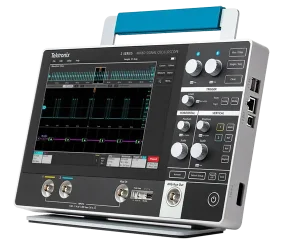
Verified, original test hardware ready for immediate global logistics dispatch. Fully calibrated with complete manufacturer documentation.







How the structural convergence of high-voltage electric mobility, renewable microgrids, and aerospace electrification is dismantling conventional unidirectional testing setups.
Traditional DC burn-in testing dissipates massive electrical loads as thermal waste via resistive banks, incurring crippling HVAC cooling expenses. Modern bidirectional DC architectures utilize active four-quadrant PWM inverters to redirect up to 96% of absorbed energy back into the industrial 3-phase local AC grid.
Next-generation electric vehicle powertrains generate rapid transitions between motor acceleration (drawing massive sourcing current) and regenerative braking (acting as an instantaneous energy sink). Bidirectional supplies execute this cross-quadrant transition in under a single millisecond without voltage overshoot.
Solar photovoltaic architectures and commercial EV drivetrains have decisively shifted from legacy 400V designs toward 800V–1500V operating ceilings. Sourcing manufacturers in China have optimized topology density, cramming 30 kW into compact 3U chassis designs rated up to 2,250 VDC.
Key technical benchmarks international Tier-1 automotive integrators, aerospace testing labs, and industrial buyers prioritize during vendor vetting.
| Evaluation Parameter | Legacy Testing Configurations | Advanced Bidirectional DC Systems | Strategic Impact on Engineering ROI |
|---|---|---|---|
| Hardware Integration | Discrete DC power supply paired with separate electronic DC load | Single chassis two-in-one bidirectional source & regenerative sink | Reduces rack footprint by 60%, simplifies wiring, and eliminates relay switching errors. |
| Quadrant Switching Delay | 50 ms to 250 ms (Mechanical relay disconnect or software dead-band) | < 1 ms seamless electronic zero-crossing quadrant commutation | Prevents voltage collapse and protects downstream traction inverters from catastrophic blowouts. |
| Energy Reclamation | 0% (100% converted into heat dissipated into facility floor) | 94% – 96.5% active backfeeding into the facility grid at high PF (>0.99) | Directly amortizes capital equipment expenditure within 18–24 months of heavy production cycling. |
| Transient Slew Rate | Fixed slope; typical ramp times from 10 ms to 100 ms | User-programmable slew rates up to 500 V/ms and dynamic resistance simulation | Enables realistic emulation of fluctuating electrochemical impedance and cold-crank surges. |
| Harmonic Distortion (THD) | Unregulated or passive harmonic filters causing grid noise | Active Power Factor Correction (PFC) with input/output current THD < 3% | Ensures pristine grid compliance with IEEE 519-2022 standards without disrupting plant robotics. |
When selecting Chinese manufacturers for high-power installations, scrutinize dynamic response times under non-linear loads. Many cost-competitive units boast excellent steady-state specifications but exhibit significant voltage sagging or high overshoot during abrupt 10% to 90% load steps. Insist on verifying factory automated test records covering step-response oscilloscope captures and current commutation phase curves before issue of final bills of lading.
How versatile bidirectional architectures empower end-to-end verification across core global high-growth technology vectors.
Modern traction inverters and On-Board Chargers (OBC) demand bi-directional verification. As vehicles support Vehicle-to-Grid (V2G) and Vehicle-to-Load (V2L) functionalities, test rigs must effortlessly switch between delivering battery charging currents and absorbing continuous high-voltage power back from the onboard AC/DC bridge.
Battery Energy Storage Systems (BESS) require accelerated lifetime degradation testing. Bidirectional DC supplies mimic solar photovoltaic arrays with precise I-V curve tracking under cloudy, dynamic ambient profiles, while simultaneously functioning as energy sinks to validate inverter conversion performance.
Hybrid electric aircraft, airborne radar, and satellites depend on highly stable 270 VDC and 28 VDC distributed bus systems. Bidirectional test power supplies reproduce complex surge patterns, sudden line dropouts, and regenerative inductive kickbacks from actuation servos.
Bridging Chinese advanced hardware manufacturing with Western regulatory compliance, ISO certification, and secure multi-tier logistics.
Exported test equipment is calibrated in accredited laboratories compliant with ISO/IEC 17025. Standard protocols ensure all voltage, current, and impedance readings maintain unbroken traceability back to NIST, CNAS, or DAkkS reference standards, satisfying international quality audits.
Operating a bidirectional regenerative power supply requires strict compliance with international grid interconnection regulations to prevent unintentional anti-islanding and harmful harmonic feed-in.
Sensitive test equipment easily incurs internal misalignment during ocean or long-distance air freight. Shipments leverage engineered shock-isolated wooden enclosures, multi-layer hermetic vapor sealing, and integrated impact loggers to ensure hardware integrity upon arrival.
Strategic technological inflection points setting future standards for high-voltage DC power simulation.
The replacement of legacy silicon IGBTs with Silicon Carbide (SiC) MOSFETs within internal power switching topologies is transforming power densities. Switching frequencies exceeding 100 kHz drastically shrink internal inductive filters, yielding lightweight 15 kW units in 2U footprints with thermal losses dropping by over 40%.
Future bidirectional supplies integrate embedded edge neural microcontrollers that automatically detect downstream load capacitance and line inductances. The power supply dynamically tunes internal PID parameters in real-time, preventing control-loop oscillations and eliminating system instability when testing uncharacterized prototype loads.
Seamless communication interfaces (EtherCAT, CANopen, SCPI over 10GbE) allow bidirectional supplies to serve as physical actuators within Hardware-in-the-Loop (HIL) ecosystems. Test setups can execute cloud-synchronized digital twin simulations of full EV drive cycles directly coordinated via MATLAB/Simulink and LabVIEW pipelines.
In-depth responses resolving engineering questions on bidirectional hardware architecture, logistics validation, and lifecycle maintenance.
Comprehensive portfolio of signal analyzers, multiport network calibration references, and portable mixed-signal oscilloscopes.