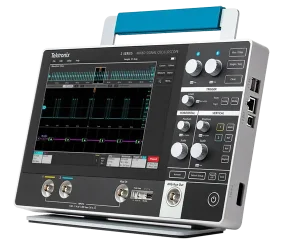
Explore our export-certified instruments, calibrated pressure standards, and high-speed multi-channel analyzers trusted by international metrology laboratories.







A rigorous architectural review for global procurement leads, metrology laboratory directors, and manufacturing engineers evaluating sub-micron precision hardware.
Position displacement measurement underpins modern microelectronics, aerospace turbomachinery alignment, and precision automated manufacturing. Selecting the optimum exporter requires a clear understanding of transducer mechanics, frequency response limits, and environmental vulnerability factors across sensor architectures:
| Displacement Technology | Measurement Principle | Typical Resolution | Frequency Bandwidth | Primary Industrial Constraint |
|---|---|---|---|---|
| Laser Interferometer | Optical phase interference (He-Ne / diode) | 0.01 nm to 0.1 nm | Up to 50 kHz dynamic | Refractive index shifts from ambient temperature/pressure |
| Capacitive Displacement | Electric field permittivity & electrode distance | 0.05 nm to 0.5 nm | Up to 100 kHz | Requires clean, non-condensing target environments |
| LVDT (Inductive Linear) | Differential transformer magnetic flux | 0.1 µm to 1 µm | 250 Hz to 2 kHz | Physical contact probe wear & mechanical inertia |
| Eddy Current (Inductive) | High-frequency magnetic oscillation & impedance | 0.1 µm to 0.5 µm | Up to 25 kHz | Material-dependent conductivity calibration (ferrous vs non-ferrous) |
| Confocal Chromatic | Wavelength-encoded focal dispersion | 10 nm to 50 nm | Up to 30 kHz | Optical probe tilt tolerance (±15° to ±30°) |
| Optical Linear Scale / Encoder | Phase grating scanning reticle | 1 nm to 10 nm | Velocity up to 10 m/s | Mechanical mounting clearance & particulate contamination |
When selecting a supplier, enterprise procurement teams must ensure that their displacement exporter provides both raw sensor heads and matched signal conditioning electronics, including Low-Noise Preamplifiers, ADC Digitizers, and Fieldbus Interfaces (EtherCAT, Profinet, Modbus-TCP). Sourcing mismatched modules often causes thermal drift and non-linearity.
Bridging global regulatory hurdles through strict multi-jurisdiction certification, accredited traceable documentation, and field-readiness guarantees.
Every exported position displacement gauge and calibrator undergoes primary metrological verification. Machine-Win provides certificates traceable to NIST, CNAS, and PTB national metrology institutes, eliminating acceptance friction for defense, medical, and semiconductor fabrication audits.
Industrial position sensors must operate near variable-frequency drives, plasma cutters, and high-voltage servomotors. Our supplied displacement transducers comply with EN 61326-1 industrial EMC radiation and conducted susceptibility standards, bearing CE, UKCA, and FCC conformance marks.
Environmental compliance is non-negotiable for enterprise OEMs. All sensors, cabling assemblies, and signal processing chassis exported conform fully to EU Directive 2011/65/EU (RoHS 2.0) and REACH regulation (EC No 1907/2006), supported by certified material testing laboratory declarations.
Sensor failures can halt entire assembly lines. Machine-Win operates bonded export inventory centers in Shenzhen and Hong Kong, providing express turnaround on replacement sensor probes, matched flex cables, and electronic modules with same-day emergency dispatch options.
Combining the Greater Bay Area’s high-precision manufacturing, micro-machining ecosystems, and rapid technological scaling for maximum cost-performance.
Shenzhen and the Pearl River Delta house the world's most concentrated precision tooling, optical crystal manufacturing, and microelectronic SMD clusters. This enables our position displacement supply chain to achieve sub-micron precision machining for probe casings, high-purity coil winding for LVDTs, and fast PCB assembly.
Where Western OEMs frequently quote 16 to 28 weeks for displacement sensor batches or specialized vacuum-compatible mounting flanges, our factory network provides rapid prototyping in 7 to 10 days, and full batch export execution in under 4 weeks without compromising metrological tolerances.
Eliminate excessive brand markups while preserving high measurement fidelity. By sourcing through Machine-Win's direct factory-tier relationships and consolidated multi-brand export channels, global clients regularly achieve 30% to 50% procurement cost savings over regional distributors.
Addressing the complex technical and commercial purchasing criteria required by multinational Tier-1 manufacturers, defense contractors, and research consortia.
Procuring precision displacement instrumentation is more than matching datasheet specifications. Leading international companies follow a multi-tier risk mitigation framework before confirming vendor qualification:
Procurement teams require unified displacement instrumentation capable of synchronizing multiple linear (X-Y-Z) and tilt (θx, θy) axes. Exporters must supply multi-channel controllers featuring hardware trigger synchronization with jitter below 10 nanoseconds.
Demands vary from ultra-high vacuum (UHV 10-9 mbar) cleanroom compatibility for semiconductor photolithography to IP68 hermetic sealing for wet machining, oil-mist environments, and high-radiation nuclear inspection lines.
Instead of managing 20+ separate vendor accounts for oscilloscopes, pressure calibrators, and displacement sensors, buyers prefer a single partner like Machine-Win who verifies, calibrates, packs, and exports mixed-brand orders under one bill of lading.
Technological transformations shaping the next decade of high-speed automation, predictive vibration diagnostics, and sub-atomic positioning systems.
As semiconductor lithography advances into EUV and sub-2nm nodes, stage positioning requirements have migrated from nanometer scales to picometer resolutions. Next-generation displacement exporters are rolling out dual-frequency heterodyne laser systems that compensate for air turbulence in real time via multi-wavelength optical channels.
Traditional non-linear lookup tables are being replaced by onboard neural networks running inside FPGA controllers. These AI micro-models read embedded thermal sensors within the transducer housing, dynamically adjusting displacement curves to cancel ambient thermal expansion drift in real time.
Modern factory architectures require position and runout sensors to communicate directly with edge industrial controllers without intermediate digitization converters. High-speed Gigabit Time-Sensitive Networking (TSN) and OPC UA protocols are becoming factory defaults on displacement controllers.
Real-world engineering deployments where sub-micron displacement accuracy directly safeguards operational throughput and prevents catastrophic mechanical failure.
In wafer stepper stages and atomic force microscopy (AFM), multi-axis capacitive and laser interferometer sensors provide real-time position feedback with sub-nanometer closed-loop accuracy, ensuring repeatable alignment during multi-patterning exposure.
High-temperature eddy current sensors monitor shaft radial vibration, axial thrust movement, and thermal expansion in power plant gas turbines and aircraft jet engines, providing early warning of bearing wear and rotor imbalances.
Dual-head confocal chromatic and laser triangulation sensors scan cathode/anode slurry coatings at line speeds exceeding 80 m/min. Continuous micron-level differential measurement guarantees coating uniformity and prevents thermal runaway hazards.
Optical linear scales and high-speed inductive linear probes mounted on 5-axis machining centers calculate tool wear, workpiece datum positioning, and spindle thermal growth compensation in real time, sustaining micron tolerances across long runs.
Detailed technical, compliance, and logistics clarifications for international procurement managers and test engineers.
Explore our specialized power analyzers, signal sources, modular data acquisition hubs, and lab oscilloscopes ready for export.








