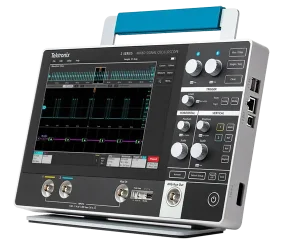
Direct supply of genuine, fully traceable RF analyzers, quantum pulse mainframes, and multichannel mixed-signal test instrumentation directly from authorized distribution channels.








Strategic analysis of precision signal excitation, Direct Digital Synthesis (DDS), and the accelerating migration toward wide-bandgap semiconductor stress testing.
In modern electronic engineering, quality assurance, and automated test environments (ATE), Function Pulse Generators and Arbitrary Waveform Generators (AWG) represent the indispensable sensory excitation engines of metrology. As global manufacturing transitions from standard silicon microelectronics to high-frequency Wide-Bandgap (WBG) materials like Silicon Carbide (SiC) and Gallium Nitride (GaN), the demands placed on electronic signal sources have undergone an exponential paradigm shift.
Historically, function generators were evaluated on fundamental analog metrics: basic sine distortion, square wave symmetry, and straightforward frequency ranges up to 20 MHz. Today’s commercial and industrial landscape demands nanosecond to sub-picosecond rise and fall times, complex multi-level PAM-4 signal syntheses, ultra-low spurious-free dynamic range (SFDR > -75 dBc), and deterministic channel-to-channel synchronization down to femtosecond tolerances.
Modern power switching circuits operating at hundreds of kilohertz require pulse generators capable of producing transition times under 1.5 ns to accurately characterize dV/dt gate degradation and parasitic resonance.
High-density optical transceivers and phase-array radar simulation necessitate ultra-stable rubidium or OCXO referenced timebases, suppressing phase noise down to < -135 dBc/Hz at 10 kHz offsets.
DDS engines combined with true point-by-point arbitrary memory playback prevent the omission of critical transient anomalies, glitch simulations, and high-frequency harmonics during accelerated stress testing.
Selecting the optimal instrument architecture depends strictly on the trade-offs between sampling rates, phase continuity, memory depth, and transient edge fidelity.
| Architectural Paradigm | Core Methodology | Primary Strengths | Inherent Trade-Offs | Recommended Industrial Scope |
|---|---|---|---|---|
| Direct Digital Synthesis (DDS) | Phase accumulator indexing a look-up table with fixed clock conversion. | Frequency Agility Continuous phase switching, cost-efficient scaling. | Point skipping causes jitter at non-subharmonic output frequencies. | General RF carrier test, educational benchtop, audio/vibration characterization. |
| True Point-by-Point Arbitrary (Arb) | Variable sampling clock synchronized to sequential memory retrieval. | Waveform Fidelity 100% signal preservation, zero dropped edge anomalies. | Higher memory controller cost, lower max clock compared to pure DDS. | Biomedical pulse replication, cardiac pacemaker testing, sensor simulation. |
| Dedicated Fast Pulse Generators | ECL/PECL/GaAs analog driver topologies with programmable ramp control. | Picosecond Rise Times Extremely low jitter (<10ps), massive voltage windows. | Limited arbitrary curve shapes (predominantly pulse, square, ramp). | Semiconductor TDR, SiC gate stress, double-pulse power converter validation. |
| Microwave Vector Signal Sources | I/Q modulation mixer topologies upconverting digital baseband streams. | Gigahertz Bandwidth Coherent modulation, EVM < 0.5%, wide dynamic range. | Complex RF calibration requirements, significant capital investment. | 5G/6G FR2 test, radar chirping, quantum computing microwave qubit drive. |
How the Greater Bay Area’s integrated hardware supply chain transforms lead times, component yield, and industrial procurement competitiveness.
Our Shenzhen and Hong Kong operational nexus leverages tier-1 surface-mount component supply chains, yielding multi-layer PCBAs with controlled impedance traces optimized for sub-nanosecond rise-time fidelity within a 48-hour prototype-to-batch window.
Every wholesale pulse generator undergoes strict automated thermal cycling (-10°C to +55°C) and multi-point calibration referenced against NIST-traceable frequency standards, eliminating intermediate distributor margins while guaranteeing calibration certificates.
By standardizing on high-throughput FPGA carrier boards and modular analog front-ends (AFEs), factory tooling costs are amortized over extensive production volumes, resulting in a 35% to 50% capital expenditure advantage for wholesale enterprise orders.
Real-world integration of pulse synthesis platforms across high-consequence engineering domains.
Generating precise asymmetric nanosecond gate pulses with programmable dead-times to validate dynamic shoot-through protection in 800V EV traction inverters without destroying expensive prototypes.
Emulating severe ISI (Inter-Symbol Interference) and sinusoidal jitter on PCIe 5.0 and USB4 differential lines using high-sample-rate arbitrary waveform sequences for receiver tolerance qualification.
Creating highly synchronized, phase-continuous linear frequency modulated (LFM) chirps and staggered pulse repetition intervals (PRI) to verify radar warning receivers and TACAN/DME avionics stations.
Delivering phase-coherent microwave envelope pulses with nanosecond gate precision to execute high-fidelity single and two-qubit rotation gates inside cryogenic dilution refrigerators.
The convergence of Gallium Arsenide DACs, AI-driven parameter synthesis, and scalable PXIe modularization.
Monolithic microwave integrated circuits (MMICs) utilizing advanced indium phosphide (InP) processes are pushing native analog bandwidths past 30 GHz, permitting direct carrier synthesis for sub-terahertz communications without external analog upconverters.
Embedded edge machine learning engines are now integrated directly into FPGA signal processing layers, dynamically compensating for impedance mismatches, cable skin effects, and probe loading in real time to deliver true-to-code waveforms at the DUT terminal.
Modern quantum information systems and 6G massive MIMO demand seamless expansion from 2 channels to over 64 tightly synchronized channels with inter-module skew controlled under < 5 picoseconds across distributed chassis.
Essential checklist for procurement directors, laboratory managers, and system integrators sourcing wholesale function pulse generators.
Wholesale procurement of high-value test and measurement instruments requires a balanced assessment across capital expense, software longevity, and metrological accountability. Below is the technical compliance framework utilized by Fortune 500 procurement teams:
Ensure that vendor quotes include ISO/IEC 17025 accredited calibration documentation with explicit calibration interval recommendations and unexpired traceable standards to NIST or national equivalents.
Verify native IVI-C, IVI-COM, and LabVIEW driver support, accompanied by standardized SCPI (Standard Commands for Programmable Instruments) over LXI/Ethernet, USBTMC, and GPIB to prevent legacy ATE migration bottlenecks.
Select manufacturers providing guaranteed component availability for at least 7 to 10 years, local repair depot access, firmware security patching, and transparent advance replacement service level agreements (SLAs).
Need volume pricing, multi-channel customization, or specific hardware options for your lab expansion? Machine-Win’s senior instrumentation engineers provide direct factory-backed assessments within 24 hours.
Direct answers addressing technical parameters, wholesale procurement logistics, and metrology standards.
Complete your laboratory verification loop with industry-standard mixed-signal digitizers, vector network analyzers, and precision calibration platforms.