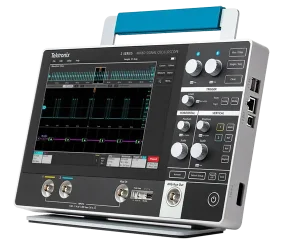
Precision custom analog modular synthesis demands strict laboratory-level metrology. Discover the original, calibrated hardware platforms used to validate VCO tracking, harmonic dispersion, and signal path purity.
Bridging organic acoustic nuance and strict electrical repeatability: How leading contract manufacturers achieve sub-millivolt precision in 1V/Octave tracking, nonlinear filter saturation, and low-noise operational circuitry.
The core challenge in custom analog modular synthesizer manufacturing lies within the non-linear relationship of bipolar junction transistors (BJTs) when converting linear Control Voltage into exponential frequencies (1V/Octave standard). In uncompensated topologies, ambient temperature fluctuations induce exponential pitch drift exceeding 30 cents per degree Celsius.
Our engineering methodology integrates precision matched dual-transistor arrays (such as THAT3004 or modern monolithic matched pairs) thermally coupled with custom +3300 ppm/°C platinum-film Tempco resistors. Calibrated using multi-channel high-speed digital digitizers and Keysight high-definition oscilloscopes, our custom VCO sub-assemblies achieve frequency stability across a continuous 6-octave span with pitch drift under ±1.5 cents from 15°C to 45°C.
Analog subtractive synthesis relies fundamentally on voltage-controlled filters (VCFs)—including 4-pole transistor ladders, diode ladders, state-variable (OTA-based), and operational transconductance cells. Custom modular manufacturing demands micro-tolerancing of polypropylene film capacitors and matched inductors to ensure the self-oscillation threshold remains surgically accurate across production runs.
By testing harmonic dispersion on Rohde & Schwarz signal and spectrum analyzers, our engineering staff tunes non-linear transfer functions to deliver authentic second- and third-order harmonic excitation. Production units preserve rich psychoacoustic warmth while guaranteeing a -92 dB noise floor when gates are inactive, preventing cumulative audio buss hiss in complex modular matrix systems.
Analog modular synthesis has broken out of boutique musician niche markets into enterprise-tier sound design, psychoacoustic research, aerospace sonification, and commercial hardware product ecosystems.
Tier-1 film scoring institutions and game audio studios require infinite dynamic headroom and authentic micro-tonal flexibility. Our custom high-voltage ±15V rail systems eliminate digital quantization clipping, yielding ultra-dense sub-bass transients and cinematic drones that cannot be synthesized via software plugins.
Academic research centers and neurobiology laboratories utilize our ultra-pure sine wave oscillators and precision low-frequency envelope generators for auditory brainstem response (ABR) profiling, binaural entrainment tests, and frequency-following response (FFR) measurements where harmonic distortion must not interfere with experimental outcomes.
Global boutique instrument brands seeking rapid expansion partner with our turnkey OEM/ODM engineering division. We translate initial schematic concepts into commercially certified Eurorack modules, complete with CNC-milled anodized aluminum front panels, industrial potentiometers, automated SMT fabrication, and CE/FCC compliance.
The convergence of classic discrete analog design with cutting-edge micro-controllers, high-speed digital buses, and neural algorithmic patch routers.
While the primary audio oscillator and filter stages remain 100% discrete analog to preserve infinite harmonic resolution, our forward roadmap embeds 32-bit ARM Cortex-M7 and RISC-V co-processors dedicated to auto-calibration routines, real-time temperature sensing, and predictive V/Oct lookup-table adjustments.
This hybrid approach delivers instant warm-up times, digital preset memorization via digitally controlled analog switches (DG408/DG411), and seamless MIDI-CI (Capability Inquiry) integration without degrading genuine analog tone.
Traditional 7-bit MIDI (128 steps) introduced audible stepping when modulating analog filters. Our upcoming module product lines feature native MIDI 2.0 transceivers with 32-bit protocol resolution, mapped directly to 16-bit low-noise digital-to-analog converters (DACs).
This provides over 65,536 discrete voltage intervals per octave, ensuring micro-tonal modulation curves with zero zipper noise while retaining analog patch-cord interconnectivity.
Addressing environmental sustainability and high-humidity tour reliability, we are rolling out conformal potting compounds that resist moisture ingress and electrostatic shock without altering the dielectric constant of critical timing capacitors.
Modular enclosures utilize 100% recyclable aerospace 6061-T6 aluminum alloys anodized using low-VOC biochemical processes, exceeding ISO 14001 environmental requirements.
Leveraging Shenzhen and the Greater Bay Area's comprehensive electronics cluster to deliver unmatched SMT throughput, rigorous component tracing, and cost-optimized mass production.
One of the greatest hazards in custom analog synthesizer manufacturing is the obsolescence of legacy audio chips (e.g., CEM3340, SSM2044, Curtis chips, vintage Bucket Brigade Delay ICs). Our direct supply network maintains audited inventories of modern reissued analog semiconductors (Coolaudio, Alfa RPAR, That Corp) and high-reliability passives.
With centralized procurement hubs in Shenzhen and Hong Kong, our buyers mitigate multi-source lead-time risks, guaranteeing continuous multi-year production schedules for international OEM clients.
Analog modular instruments require high mechanical resilience for panel-mounted potentiometers, 3.5mm jacks, and toggle switches, combined with microscopic SMT precision for multi-stage operational amplifiers. Our factory floor operates high-speed Yamaha and Fuji pick-and-place lines supporting 0201 passives, BGA packages, and selective wave soldering.
Each soldered PCB passes through 3D Automated Optical Inspection (AOI) followed by 100% functional manual audio probing to eliminate dry solder joints, parasitic capacitance, and ground loop anomalies.
Analog components undergo natural drift during their initial power-on cycles. To guarantee that every shipped module operates perfectly out of the box, our factory subjects all assembled boards to a 72-hour burn-in phase in environmental chambers cycling from 0°C to 50°C.
Oscillators undergo post-thermal fine calibration using precision Tektronix and Keysight oscilloscopes to lock in the 1V/Octave tracking curve, ensuring end users receive modules that stay in tune regardless of geographic climate.
Meeting the rigorous safety, electromagnetic emission, and hazardous material regulations of North American, European, and Asia-Pacific markets.
High-gain analog modules (such as distortion units, wavefolders, and high-frequency oscillators) can inadvertently radiate RF noise or fall victim to cell phone tower interference. Our engineering designs incorporate multi-layer ground planes (4-layer and 6-layer FR4 boards), ferrite bead power supply filtering, and full Faraday shielding.
All custom builds are pre-scanned in our anechoic chambers to guarantee full compliance with FCC Part 15 Class B and EN 55032 electromagnetic compatibility standards.
Exporting electronic equipment to the European Union and worldwide requires strict chemical traceability. Every component in our supply pipeline—from lead-free SAC305 solder paste to PCB laminates and potentiometer lubricants—is certified under RoHS Directive 2011/65/EU and REACH (EC 1907/2006).
Comprehensive full-material declaration (FMD) documents are provided to client procurement divisions for streamlined customs entry.
Precision analog synthesizers are sensitive instruments vulnerable to shock, electrostatic discharge (ESD), and moisture variation during transit. We implement custom antistatic bubble packaging, silica desiccant inserts, and multi-wall reinforced corrugated exterior cartons compliant with ISTA-3A drop test standards.
With global air freight hubs in Hong Kong and Shenzhen, we handle customs clearance, export declarations, and door-to-door delivery across North America, Europe, Japan, and Australia.
Original brand-new instruments utilized by engineering labs to perform rigorous characterization, digital bus verification, and electrical safety diagnostics.
Essential insights for engineering leads, procurement officers, and modular synthesizer brand managers evaluating custom analog manufacturing capabilities.