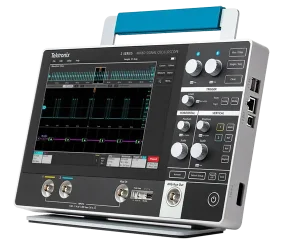
Enterprise-grade signal analyzers, digital storage oscilloscopes, vector network instruments, and precision multichannel acquisition modules available for rapid worldwide deployment.






Analyzing the evolution of 4-quadrant source-measure instrumentation across advanced semiconductor manufacturing, wide-bandgap (WBG) power electronics, and sub-nanometer node research.
A Source/Measure Unit (SMU) represents the pinnacle of precision electronic measurement. By tightly integrating the operational characteristics of an ultra-clean DC power supply, a 6½ or 7½ digit digital multimeter (DMM), a true current source, an electronic load, and a precision pulse generator into a unified, synchronized chassis, SMUs eliminate the classic cable-reactance, switching delay, and ground-loop errors inherent in discrete test racks. Today's commercial SMU landscape is driven by the urgent mandate for simultaneous force-voltage/measure-current (FVMI) and force-current/measure-voltage (FIMV) capabilities operating at femtoampere (10-15 A) current resolutions and microvolt (10-6 V) potentials.
In the current semiconductor fabrication cycle, Moore's Law transitions into the "More than Moore" and Angstrom-scale packaging eras. Gate dielectric leakage, FinFET subthreshold swings, and nanosheet gate-all-around (GAA) architectures require test environments capable of extracting electrical parametric profiles without injecting capacitive charge dissipation or parasitic thermocline distortion. Consequently, high-end export SMUs must deliver ultra-low intrinsic noise levels, rapid feedback loop settling times within microseconds, and tight trigger synchronization with automated wafer probers, RF matrix switches, and cryostat test benches.
| SMU Class Architecture | Primary Voltage/Current Dynamic Range | Measurement Settling Speed | Dominant Global Applications |
|---|---|---|---|
| General Purpose Precision (Benchtop) | 100 nV – 210 V / 10 fA – 3 A (10.5 A pulsed) | 100 µs – 1 ms feedback loop | Automated sensor calibration, LED/laser diode characterization, academic research. |
| High-Power Pulse SMU | Up to 3,000 V / Up to 100 A pulse | < 50 µs pulse rise times | Wide Bandgap (SiC, GaN) MOSFET breakdown, IGBT dynamic on-resistance. |
| Low-Leakage Sub-Femtoamp SMU | 1 µV – 200 V / 0.1 fA – 1 A | High capacitive drive (> 100 nF) | Quantum computing (qubit gate leakage), graphene nanoribbons, wafer dielectric integrity. |
| Multichannel Modular (PXIe-based) | Multi-channel synchronous 20 V – 200 V | Digital hardware trigger bus (< 1 ns) | Massive parallel production testing for PMICs, RF front-end modules, and display drivers. |
How the integration of Shenzhen’s electronics hardware corridor and Hong Kong’s global logistics framework reshapes the economics of precision test and measurement distribution.
Direct proximity to tier-1 component foundries and precision passive component fabrication in the Pearl River Delta reduces Bill of Materials (BOM) cycle times by 65% compared to Western counterparts, yielding unmatched agility in system configuration.
Every exported unit passes through climatic screening (-20°C to +55°C burn-in chambers) and is calibrated using National Institute of Metrology (NIM) and Fluke reference multi-product calibrators, ensuring rigorous global traceability.
Combining the Shenzhen export processing infrastructure with Hong Kong's free-trade international air cargo gateways allows Machine-Win to dispatch calibrated, dual-boxed, shock-monitored equipment to over 100 countries in under 96 hours.
SMUs and precision test arrays mapped directly to mission-critical fabrication lines, QA laboratories, and field metrology depots.
In GaN and SiC power foundries across Europe and North America, SMUs execute static and dynamic on-state resistance (RDS(on)) sweeps, gate threshold voltage (Vth) drift analysis, and reverse leakage testing under voltages up to 3 kV.
Battery research facilities utilize continuous 4-quadrant bipolar operation to smoothly switch between sourcing current (charging) and sinking current (discharging), establishing micro-Ohm internal resistance profiles via electrochemical impedance spectroscopy.
Photonic Integrated Circuit (PIC) and micro-LED production demands multi-channel SMUs to sweep current profiles across optical emitters while synchronously measuring the photocurrent output of reference photodiodes with zero latency.
Anticipating structural shifts in test equipment acquisition, vendor qualification criteria, and capital asset management through 2030.
High-volume manufacturing plants are transitioning from proprietary benchtop enclosures to high-density PXIe chassis. This shift decreases automated test equipment (ATE) footprint by over 70% while drastically increasing channel counts per rack.
Tier-1 Western OEMs currently face delivery lead times extending up to 36 to 52 weeks for specialized low-current SMUs. Machine-Win's strategic buffer inventory and multi-brand stocking network mitigate supply chain disruption, ensuring delivery within 5-10 business days.
Enterprise procurement teams no longer look solely at unit price. Factorized TCO assessments prioritize calibration interval longevity (guaranteed 1-year and 2-year drift specifications), modular board repairability, and seamless SCPI command emulation.
Technical guidance compiled by our international field support and metrology certification team.
A standard power supply is typically unipolar (Quadrant I only) with coarse measurement resolution (milliamperes/millivolts). A Source/Measure Unit operates across four quadrants (sourcing and sinking positive and negative voltage/current) with native nanoampere/femtoampere sensitivity, microsecond feedback settling, and built-in guard shielding to eliminate triaxial cable leakage currents.
When measuring currents below 1 nA, the insulation resistance of standard coaxial cables causes parasitic leakage that obscures the true Device Under Test (DUT) performance. Driven guarding surrounds the high-impedance lead with a conductor maintained at the exact same potential, resulting in zero voltage drop across the dielectric and completely eliminating cable leakage currents.
Every precision instrument is enclosed in ESD anti-static barriers, encased in custom-molded high-density polyethylene dampening shells, and packed within reinforced export crates outfitted with multi-axis mechanical shock and tilt indicators. Complete calibration documentation with factory serial number traceability is included inside waterproof enclosures.
Yes. In addition to hardware supply, our engineering center provides turn-key test integration, including customized low-noise triaxial test fixtures, wafer prober connection manifolds, and fully validated LabVIEW, Python, and MATLAB automation drivers matching your target test environment.
Original, brand-new calibrators, quantum control hardware, high-speed BERT systems, and portable multi-signal analyzers configured for immediate export delivery.