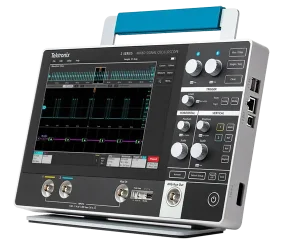
Explore high-performance analyzers, calibrators, and mixed-signal oscilloscopes fully integrable with custom GPIB/GPLB, RS-232/422/485 serial buses, and LXI/Ethernet automated test environments.
A comprehensive examination of physical layer bridges, SCPI command translation pipelines, and modern test rack telemetry across legacy and high-throughput communication standards.
In modern industrial automated test environments (ATE), legacy instrumentation architectures and advanced Gigabit network backbones frequently clash. The General Purpose Interface Bus (GPIB), originally developed as HP-IB and standardized under IEEE-488.1 and IEEE-488.2, has served as the backbone of precision benchtop metrology for over four decades. However, as contemporary smart factories transition toward distributed, cloud-integrated SCADA networks and LXI (LAN eXtensions for Instrumentation) protocols, manufacturing enterprises face a critical challenge: integrating multi-million dollar legacy instruments with modern high-speed Industrial Ethernet and multi-drop Serial (RS-232/422/485) control systems.
As a specialized manufacturer and global exporter, our embedded bus bridging hardware resolves protocol mismatches by delivering high-throughput SCPI (Standard Commands for Programmable Instruments) virtualization. By embedding high-speed ARM Cortex and RISC-V co-processors with tailored FPGA handshaking logic, our custom converters buffer, translate, and packetize IEEE-488 signals into TCP/IP sockets, VXI-11, HiSLIP (High-Speed LAN Instrument Protocol), and raw serial streams with virtually zero jitter.
Equipped with dual-core real-time processors and hardware handshaking logic to manage IEEE-488.1 talker/listener handshakes (DAV, NRFD, NDAC) in pure hardware, eliminating software-induced bus stalls.
Seamlessly multiplexes GPIB/GPLB, full-duplex RS-232, differential RS-422/485, and 10/100/1000 Base-T Ethernet without altering existing LabVIEW, Python (PyVISA), or C# software stacks.
Designed for severe electromagnetic interference (EMI) environments. Provides 2.5 kVrms continuous galvanic isolation across power, logic, and bus transceiver stages to prevent destructive ground loops.
Combining world-class high-density SMT fabrication, agile hardware prototyping, complete supply chain ownership, and rigorous quality control according to ISO 9001 and IPC-A-610 Class 3 standards.
China's Pearl River Delta (Shenzhen-Dongguan cluster) has emerged as the global epicenter for precision electronic manufacturing and automated test engineering. Producing custom GPIB/GPLB serial and Ethernet communication modules demands not only surface-mount assembly expertise, but also deep vertical integration across specialized transceiver IC sourcing, micro-machined shielded connectors, automated optical inspection (AOI), and full-spectrum electromagnetic compatibility (EMC) testing.
Our localized manufacturing pipelines support fast-turn NPI (New Product Introduction). Rapid custom PCB layouts, embedded firmware flashing, and quick-turn enclosure machining reduce prototyping cycles from months to under 14 business days.
Direct Tier-1 relationships with passive component manufacturers, connector molders, and semiconductor foundries provide up to 40-55% bill-of-materials cost efficiency over traditional Western catalog distributors.
Every single manufactured interface board undergoes 72 hours of thermal stress screening (-40°C to +85°C), high-frequency packet flood validation, and continuous handshake verification against commercial Keysight and Tektronix test stations.
From centralized chassis-bound architectures to decentralized, IIoT-driven smart test nodes equipped with edge analytics, Time-Sensitive Networking, and WebSockets.
While traditional GPIB is constrained by cable length (max 20 meters total, 2 meters per device) and 15-device loading caps, Ethernet-based LXI and HiSLIP protocols remove distance barriers completely. Test engineers can control remote racks distributed across vast gigafactories over standard Cat6a infrastructure.
Modern custom gateways no longer act as dumb bit-pipes. Onboard microcontrollers parse SCPI command strings locally, execute pre-programmed test sequences autonomously, and transmit pre-filtered PASS/FAIL telemetries via MQTT or OPC UA directly to cloud ERP dashboards.
As test networks converge with corporate intranets, test data integrity becomes a national security concern in defense and aerospace. Next-generation Ethernet controllers integrate TLS 1.3 encryption, secure boot routines, role-based access control (RBAC), and 802.1X port authentication directly at the hardware interface.
Purpose-engineered for demanding testing cells where measurement precision, latency determinism, and zero line downtime are non-negotiable.
Integrated into automatic prober benches connecting parameter analyzers, SMUs, and pulse generators. Our controllers manage high-volume sub-picoamp DC curve tracing without introducing capacitive noise or ground loop offsets.
Controls arrays of DC electronic loads, multi-channel thermal loggers, and cell internal resistance meters over isolated serial RS-485 and Ethernet links, executing high-current charge/discharge cycles safely in extreme EMI fields.
Deployed in depot-level flight line test sets. Bridges legacy military IEEE-488 navigation analyzers, TACAN station testers, and RF synthesized signal generators directly to ruggedized flight-line rugged tablets via secure Wi-Fi/Ethernet bridges.
Enables long-distance telemetry in electrical substations where fiber-optic-converted Ethernet gateways isolate high transient surge spikes from operators during partial discharge and winding resistance measurements.
Synchronizes multi-channel Bit Error Rate Testers (BERT), optical modulation analyzers, and tunable laser sources, managing high-throughput multi-lane eye diagram analysis at 400G and 800G optical production yields.
Key technical parameters, regulatory mandates, and supply chain verification checkpoints demanded by Fortune 500 procurement teams and sovereign calibration laboratories.
Global procurement directors and test engineering managers operating across North America, the European Union, Japan, and Southeast Asia face complex vendor audits when sourcing custom communication hardware. A reliable interface gateway must satisfy strict hardware reliability metrics, complete software compatibility matrices, and unbroken compliance chains.
Seamless operation depends on standardized VISA (Virtual Instrument Software Architecture) libraries. Verified hardware must act as a drop-in replacement across National Instruments NI-VISA, Keysight IO Libraries Suite, and Rohde & Schwarz VISA platforms.
All manufactured units exported globally comply with CE (EMC Directive 2014/30/EU), FCC Part 15 Class A, and RoHS/REACH environmental safety standards. Factory burn-in records, certificate of origin (C/O), and full commercial documentation accompany all shipments.
Industrial programs in avionics and energy require product availability guarantees exceeding 7-10 years. We offer strict component obsolescence monitoring, firmware backward-compatibility, and form-fit-function redesign guarantees.
Deploy our custom communication bridge converters with leading high-bandwidth spectrum analyzers, modular digitizers, and portable primary pressure calibrators.
In-depth technical answers addressing driver architecture, hardware handshaking, latency compensation, and international export logistics.