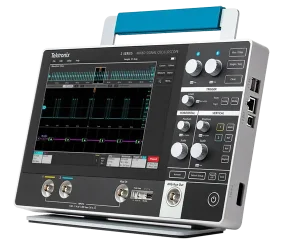
Pre-inspected, traceable instrumentation supporting complex AF sine/square waveform generation, validation, and multi-domain signal analysis.
Navigating the global transition toward ultra-low distortion Direct Digital Synthesis (DDS) and mixed-signal test architectures.
Audio Frequency (AF) Sine and Square Wave Generators represent fundamental pillars within electronic verification, transducer calibration, and automated production environments. While historically constrained to the traditional 20 Hz to 20 kHz human auditory range, contemporary industrial paradigms classify AF signal generators as precision instruments covering sub-Hertz infrastructure vibration (0.1 Hz to 100 kHz+) up through ultrasonic and digital switching transients. Global manufacturing growth—driven heavily by consumer electronics, automotive electrification (EV), and aerospace acoustic profiling—has established stringent performance benchmarks for suppliers and exporters worldwide.
Modern industrial procurement is no longer simply about purchasing a standalone signal source; it centers around total signal integrity, low total harmonic distortion (THD+N < -100 dB), ultra-low phase jitter, and seamless automated integration via SCPI, Ethernet/LXI, and USB modular interfaces. In developing and established high-tech economies alike, tier-one manufacturers demand rapid sourcing pipelines that guarantee traceability, ISO/IEC 17025 certified calibration data, and extended multi-year operational support. As high-speed communications demand ever cleaner clock references, square wave generators with sub-nanosecond rise/fall times are replacing older analog function units.
Understanding the internal engineering distinctions that dictate accuracy, frequency agility, and long-term stability.
Direct Digital Synthesis utilizes a numerically controlled oscillator, phase accumulator, and a precision high-speed DAC to map waveform lookup tables. This eliminates analog thermal drift, providing micro-Hertz frequency resolution and instantaneous phase switching.
Precision square wave generation requires high-speed differential comparators and adjustable slew-rate controls. Modern units deliver exceptional symmetry (50% ± 0.1% duty cycle) and suppress ring-back artifacts on high-impedance loads.
Suppliers integrate internal Oven-Controlled Crystal Oscillators (OCXO) or external 10 MHz reference inputs to maintain synchronization across complex multi-channel bench arrays, critical for differential acoustic and phased transducer arrays.
Where high-integrity AF sine and square wave generation forms the core of mission-critical validation.
Sine waves verify total harmonic distortion, operational frequency response, and dynamic range of high-end DACs, studio active monitors, audio DSPs, and MEMS microphones.
Square waves drive Optocouplers, gate drivers, and digital PWM circuits, simulating duty-cycle modulations and assessing dead-time execution across EV powertrain motor controls.
Simulating 4-20mA current loop pulsed transitions, frequency-encoded sensor outputs, and verifying analog input channel calibration across industrial automation cabinets.
Providing pristine reference benchmarks in universities and accredited metrology laboratories for verifying analog filter poles, operational amplifiers, and passive components.
How experienced exporters eliminate counterfeit risks, specification mismatch, and long lead times.
Cross-border procurement of precision instrumentation presents major risks: uncalibrated legacy equipment, region-locked firmware, and inadequate transit protection. When evaluating top AF sine and square wave generator suppliers, enterprise procurement departments rely on vendors offering comprehensive value-added engineering frameworks:
Experienced exporters operate dedicated engineering benches where instruments undergo full verification: frequency counter characterization, harmonic spectrum checks via high-tier analyzers, and functional firmware parameter checks before packing.
Instruments ship complete with serialized factory data sheets or secondary accredited calibration certificates (ISO/IEC 17025 standard). This ensures immediate integration into compliant pharmaceutical, aerospace, or automotive manufacturing quality systems.
Procurement teams combine waveform generators with oscilloscopes, power analyzers, and passive probes from manufacturers such as Keysight, Rohde & Schwarz, Tektronix, and Druck into a single vetted customs declaration and protected shipment.
In-depth engineering answers addressing signal purity, export requirements, and functional specifications.
Professional AF generators focus on pure spectral purity and stability within the audio and baseband spectra. They offer exceptional Total Harmonic Distortion (THD) specs (often below -90 to -105 dB), phase noise lower than -130 dBc/Hz at 10 kHz offset, flat amplitude response across load impedances, and negligible ringing during square-wave transitions.
Square waves contain extensive odd-harmonic frequency components extending far into the megahertz spectrum. If output cabling and termination do not match the generator's internal impedance (typically 50 Ω), transmission line reflections cause substantial overshoot, ringing, and edge degradation, corrupting logic tests and transient timing characterizations.
Precision calibration equipment must ship in custom engineered, multi-layered anti-static polyethylene foam cushioning, vacuum-sealed barrier packaging with desiccant packs, and heavy-duty double-wall corrugated or flight cases. Verified logistics providers additionally apply impact and tilt indicator monitors to guarantee structural and metrological integrity upon receipt.
While high-end AWGs provide immense flexibility across any mathematical waveform, dedicated AF sources often remain superior in low-noise analog performance and pure economic efficiency. Specialized AF units typically deliver a higher dynamic range and lower spurious-free dynamic range (SFDR) at significantly lower cost per test station for dedicated audio-frequency characterization.
Expand your testing and measurement infrastructure with our fully vetted, high-precision export catalog.