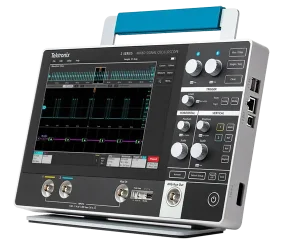
Multiplexer Module
Explore original, traceable high-accuracy measurement units, modular multiplexers, and signal calibration systems ready for international dispatch.






In-depth architectural analysis covering multi-vendor integration, edge quantization, microvolt-level physical isolation, and high-frequency structural logging.
In the modern era of automated industrial validation, Data Acquisition (DAQ) Systems represent the critical sensor-to-cloud nervous system for R&D engineering centers, smart fabrication plants, and aerospace test beds. Transforming physical world phenomena—temperature gradients, structural dynamic strain, acoustic vibrations, and transient microvolt surges—into pristine digital signals requires an uncompromising metrological foundation. With modern manufacturing operating under microscopic defect tolerances, an isolated DAQ mainframe is no longer an isolated benchtop tool; it is an intelligent edge computing gateway providing real-time data integrity, galvanic channel isolation, and multi-protocol deterministic synchronisation.
The global data acquisition market has transitioned from traditional proprietary bus standards toward heterogeneous, high-bandwidth architectures dominated by modular PXIe, LXI, and USB-C high-speed frameworks. Industrial enterprises are navigating three transformative tectonic shifts:
First, Edge Signal Pre-Conditioning and FPGA Processing: Modern DAQs incorporate dedicated on-board DSP and field-programmable gate arrays right alongside analog-to-digital converters (ADCs). This enables onboard Fast Fourier Transforms (FFT), digital filtering, and sensor linearization before transmitting gigabytes of payload across enterprise Ethernet backbones.
Second, Hybrid Channel Density & Multiplexer Versatility: R&D departments developing electric vehicle battery packs, avionics suites, and semiconductor multi-rail power distribution networks require systems like the DAQ970A / DAQ973A architectures equipped with multiplexing matrices like the DAQM901A. These configurations yield tens or hundreds of differential 2-wire and 4-wire RTD, thermocouple, and shunt current measurement nodes while maintaining microvolt-level common-mode rejection ratios (CMRR > 120 dB).
Third, Metrological Traceability & Regulatory Conformance: With ISO/IEC 17025 laboratory accreditations dictating high standards of measurement uncertainty, precision test platforms require continuous calibration loops, ultra-low temperature drift coefficients (< 2 ppm/°C), and automated internal calibration references.
Deploying switch matrices up to 20-channel differential topologies per module. Supports seamless high-speed scanning across mixed thermocouples, RTDs, and micro-ohm resistances.
Over 300V to 1000V channel-to-channel and channel-to-earth isolation eliminates harmful ground loops and shields sensitive instrumentation from industrial transients.
Full support for IEEE 1588 PTP (Precision Time Protocol) and synchronous multi-chassis triggers, guaranteeing clock alignment across distributed test benches.
Combining the world's most dense electronics manufacturing cluster with verified traceability, agile component procurement, and bonded logistical velocity.
Our dual-hub positioning in Shenzhen and Hong Kong shortens lead times, providing immediate factory-level warehousing, expedited bonded customs, and direct international air transport.
Leveraging deep industrial supply partnerships across 2,000+ certified production hubs gives clients significant capital expenditure (CAPEX) savings on instruments and precision modules.
Every single instrument undergoes rigorous electrical multi-point checks, serial verification, and full firmware configuration logging before entering specialized shock-proof packaging.
Our rapid-response bilingual engineering specialists assist procurement managers in resolving critical line-down situations, sourcing obsolete components, and designing drop-in equivalents.
From gigafactory battery cell validation to aerospace acoustic chamber characterization, see how modern DAQ units operate in field environments.
Multi-channel DAQ architectures monitor hundreds of temperature junctions and DC millivolt fluctuations across battery modules during dynamic charge-discharge cycle tests, ensuring early detection of thermal runaway.
Precision multi-channel switching matrices evaluate nanoampere leakage currents and low-voltage stability on microchip silicon rails under elevated thermal chamber stressing, logging thousands of data points per minute.
Coupled with Druck transfer standards and high-resolution strain gauge modules, DAQ units measure surface stress distributions, aerodynamic loads, and pneumatic integrity across full airframe wings during static testing.
A rigorous checklist developed by Machine-Win test engineers to streamline supplier qualification and prevent integration mismatches.
Determine whether your process requires high Number of Power Line Cycles (NPLC) for rejection of 50/60Hz line noise or ultra-fast conversion for transient capture.
Assess armature relays for low thermal offset vs. reed relays for higher switching cycles vs. solid-state switches for high-speed scanning without mechanical wear.
Ensure native driver support for SCPI, LabVIEW, MATLAB, and Python over LAN/LXI, USBTMC, or GPIB to guarantee rapid drop-in integration with legacy automated test equipment (ATE).
Demand verified factory calibration certificates with full traceability to national standards (NIST, NPL, or NIM), ensuring absolute confidence during audits.
Clear, direct answers regarding calibration validity, module compatibility, multi-vendor sourcing, and secure transit protocols.
Complement your data acquisition workflows with RF spectrum analyzers, high-bandwidth mixed-signal oscilloscopes, and vector network characterization platforms.