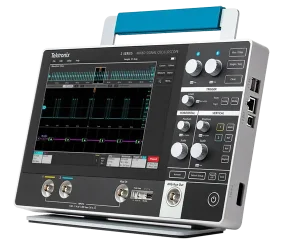
Explore high-accuracy programmable power sources, mixed-signal oscilloscopes, and automated measurement mainframes ready for global factory integration.
The convergence of wide-bandgap (WBG) semiconductors, automated smart testing, and high-density manufacturing has positioned Chinese power export infrastructure at the core of global test and measurement architecture.
Modern variable DC power supplies manufactured in China leverage third-generation Silicon Carbide (SiC) MOSFETs and Gallium Nitride switches. This achieves power densities exceeding 30W/in³ and continuous conversion efficiencies above 96%, dramatically curbing thermal dissipation in multi-rack automated test fixtures.
Unlike conventional square-matrix architectures, Chinese autoranging variable power topologies provide a wide operating curve: yielding ultra-high voltages at lower currents and mega-current delivery at step-down voltages without requiring larger frame sizes or distinct models for R&D variations.
Seamless automated testing environment (ATE) integration via native SCPI syntax, LXI Ethernet, USB-TMC, CAN-bus, and isolated RS-485 interfaces. Output command-processing latencies drop below 1.2ms, synchronizing perfectly with high-speed digital digitizers and mixed-signal oscilloscopes.
A comprehensive assessment of supply chain depth, component verticalization, and advanced quality verification mechanisms operating within Chinese manufacturing clusters.
From high-frequency planar transformer winding and custom aluminium extrusion heatsinks to automated surface-mount technology (SMT) assembly, China's Shenzhen, Dongguan, and Yangtze River Delta corridors yield unmatched turnaround agility. Custom hardware topologies can progress from blueprint to prototype within days.
Export-tier manufacturers integrate ISO/IEC 17025 accredited calibration procedures. Every benchtop and rackmount variable DC power unit is verified using traceable reference standards (including Keysight and Fluke multi-product calibrators), guaranteeing full compliance with CE, UL, RoHS, and FCC directives.
Industrial reliability demands rigorous testing. Exported power units undergo 100% full-load dynamic cycling under high-temperature (50°C) burn-in rooms for up to 72 continuous hours, virtually eliminating early mortality failures and optimizing Mean Time Between Failures (MTBF > 120,000 hours).
Evaluating electrical performance variables when selecting regulated DC voltage sources for high-precision laboratory testbeds versus high-power production testing.
| Architecture Type | Typical Voltage / Current Matrix | Ripple & Noise Dynamics | Transient Slew Rate | Thermal & Power Density | Primary Industrial Use Case |
|---|---|---|---|---|---|
| Series Linear Regulated | 0-30V / 0-5A (Fixed Square Matrix) | < 350 µVrms (Extremely Pure) | < 15 µs (Ultra Fast) | Low (~15-25% Efficiency, Heavy Frame) | Ultra-sensitive RFIC, ADC/DAC bias, low-noise audio R&D |
| Switch-Mode (SMPS Standard) | 0-600V / 0-100A (Discrete Steps) | 2 mV - 15 mVrms (High Frequency Noise) | ~ 100 µs - 1 ms | High (~85-90% Efficiency, Compact 2U) | General burn-in, electroplating, automotive harness testing |
| Digital Autoranging (SiC/GaN) | 0-1500V / 0-500A (Expanded Constant-Power) | < 1 mVrms (Active Filtered) | Programmable (0.001V/ms to 1000V/s) | Ultra-High (>96% Efficiency, 3U 15kW) | EV Battery simulation, solar PV inverter MPPT, motor drive ATE |
Targeted solutions engineered to resolve high-frequency impedance, bidirectional power recovery, and complex transient voltage simulations worldwide.
With modern e-mobility transitioning toward 800V silicon-carbide platforms, Chinese high-voltage variable DC supplies execute dynamic emulation of lithium battery packs. Supporting bidirectional sinking and sourcing, these regenerative power supplies feed up to 95% of test energy back into the plant grid during motor deceleration and regenerative braking validation.
Coupled with parameter analyzers and high-speed SMUs, precision variable DC power delivers micro-volt steps and nano-amp current clamps essential for tracing breakdown voltages (V_br), threshold shifts, and gate leakage currents across emerging wide-bandgap transistors under extreme thermal gradients.
Modern airborne radar transmitters impose intense burst current loads. Variable DC power sources utilize low-impedance output buffers and adjustable internal resistance modes to simulate aircraft 28V DC and 270V high-voltage DC bus lines (MIL-STD-704F), verifying that mission avionics handle line dropouts without rebooting.
Key technical parameters multinational procurement teams must define when contracting variable voltage DC power supply exporters from China.
Verify whether the DC power exporter guarantees transient recovery under 50 microseconds when switching load steps from 10% to 90%. Configurable voltage and current slew rates prevent inrush damage to delicate capacitive loads and downstream decoupling networks.
Industrial applications mandate non-negotiable protection features: Over Voltage Protection (OVP), Over Current Protection (OCP), Over Temperature (OTP), and Reverse Polarity Protection. Integrated remote sense connections compensate for wiring drops across extended rack cabling.
Evaluate master-slave bus topologies. Enterprise setups benefit from modular 1U/2U/3U units that dynamically configure in parallel for mega-amp arrays or in series for kilovolt testing, maintaining synchronized digital control without phase jitter.
Direct answers from our senior metrology and power supply engineering specialists.
A variable DC power supply automatically shifts between CV and CC mode based on load impedance and programmed limits. In CV mode, the unit regulates voltage to the setpoint while current floats according to Ohm's Law (I = V/R). If the load draws current exceeding the programmed ceiling, the unit switches to CC mode, capping the current and lowering voltage proportionally to prevent device burnout.
When delivering heavy currents (e.g., 50A to 500A), lead resistance generates substantial voltage drops along connection cables. In 2-wire setups, the voltage at the device-under-test (DUT) drops significantly below the power supply display reading. A 4-wire Kelvin remote sense arrangement routes separate high-impedance sensing leads directly to the DUT terminals, allowing internal feedback circuitry to dynamically compensate for lead drop and maintain exact terminal voltage.
Traditional supplies deliver maximum power only at one specific voltage and current intersection (e.g., 30V × 10A = 300W). If your test requires 60V, you must purchase a second supply. An autoranging supply delivers a constant power boundary across an expanded operational envelope (e.g., 100V, 30A within an 800W envelope), enabling a single instrument to cover diverse testing scenarios without purchasing multiple dedicated units.
All precision variable power supplies and oscilloscopes shipped internationally are housed in heavy-duty, moisture-sealed ESD barrier bags, encased inside reinforced multi-layer honeycomb cartons or custom wooden crates with drop and shock indicators. Accompanying export documentation includes traceable factory calibration reports, CE/RoHS declarations, commercial invoices, and bilingual operation manuals.
Complete your laboratory bench or automated line with industry-standard RF network analyzers, precision calibrators, and multi-slot mainframes.