
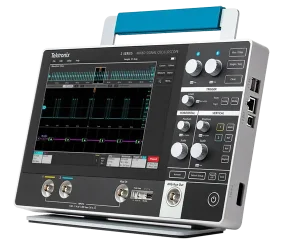
Technical Reference, High-Speed Physical Layer Validation & OEM Industrial Sourcing Architecture for Advanced Display Standards
Verified physical layer, mixed-domain, and protocol instruments engineered for laboratory characterization, automated compliance testing, and high-throughput production validation.







Understanding transition mechanisms from legacy 18 Gbps TMDS signaling to modern 48 Gbps Fixed Rate Link (FRL) architecture across contemporary video interfaces.
The standard architectural framework for HDMI up to version 2.0. TMDS uses an 8b/10b encoding structure delivering a maximum raw throughput of 18 Gbps across three differential data channels and an isolated clock reference. Precision generators must achieve lower than 0.15 UI RMS jitter across all lanes to correctly measure eye pattern closure and receiver jitter tolerance boundaries.
Standardized in HDMI 2.1b, FRL shifts the transmission scheme to 16b/18b coding, boosting aggregated bandwidth up to 48 Gbps via 3 or 4 concurrent data lanes with embedded clock timing. Industrial-grade signal generators must inject calibrated inter-symbol interference (ISI), random jitter (RJ), and sinusoidal periodic jitter (PJ) to thoroughly challenge receiver-side Equalization (CTLE + DFE).
Testing video output stability requires end-to-end control of Display Data Channel (DDC), Extended Display Identification Data (EDID) decoding, and high-bandwidth Digital Content Protection (HDCP 1.4/2.2/2.3) key negotiation state machines. Advanced signal sources incorporate real-time auxiliary loggers capable of isolating sub-millisecond I2C bus synchronization collisions.
Combining world-class component clusters, advanced high-frequency PCB manufacturing, and comprehensive global distribution channels.
The concentration of precision RF fabrication, surface mount technology (SMT) lines, and ultra-high-speed FPGA packaging infrastructure in Shenzhen and the Pearl River Delta guarantees compressed turnaround cycles for complex test instruments. Prototype-to-production lead times are reduced by up to 60% compared to Western counterparts.
International procurement teams frequently encounter fragmented order fulfillment when sourcing high-bandwidth test environments. Leveraging our tri-city operational centers in Hong Kong, Shenzhen, and Nanchang, clients consolidate mixed-brand analyzers, high-frequency probes, and HDMI pattern generators under a single customs declaration and transparent invoice.
By streamlining direct factory sourcing channels and maintaining long-term vendor distribution agreements, high-performance physical layer test instruments become available without prohibitive middleman markups, enabling consumer display OEMs to outfit entire assembly lines within strict capital expenditure budgets.
Navigating strict regional radio frequency certifications and international metrological calibration frameworks.
Every HDMI signal generator shipped to international research laboratories and tier-1 manufacturers comes with factory calibration traceable to national institutes of metrology (NIM, NIST). Detailed calibration reports clearly define voltage level accuracy, rise/fall edge symmetry (ps), and phase jitter components.
Display pattern generation involves high internal clock multipliers (up to 12 GHz fundamental frequencies). Instruments conform strictly to CISPR 32/EN 55032 Class A, FCC Part 15 Subpart B, and the RoHS directive, ensuring negligible spurious emissions that might otherwise corrupt sensitive Device-Under-Test (DUT) measurements.
Mitigating the risk of cross-border downtime: We offer comprehensive localized repair coordination, modular hardware replacements, remote firmware patching, and automated script translation (Python, SCPI, LabVIEW) to sustain continuous operation in mission-critical manufacturing facilities worldwide.
From micro-display semiconductor verification to high-throughput smart television manufacturing lines.
Validating 4K@120Hz and 8K@60Hz display pipelines requires variable frame rate (VRR), Auto Low Latency Mode (ALLM), and Quick Media Switching (QMS) simulation. Signal sources stress the receiver's sink-side decompression algorithms with DSC (Display Stream Compression) test vectors.
Smart cockpits deploying multiple high-resolution clusters depend on serialized video transmission. Signal generators simulate temperature-induced jitter, long cable signal loss, and HDCP link renegotiation under harsh in-vehicle operating conditions.
Fabless silicon designers and assembly packaging companies utilize advanced signal synthesizers to conduct parametric characterization of physical layer IP blocks, measuring bit error rates (BERT), clock skew, and transmission line eye-diagram margins.
Anticipating the demands of next-generation physical interfaces, spatial computing, and artificial intelligence integration.
As micro-LED panels and dual-8K VR headsets push beyond contemporary physical limits, signal generators are incorporating advanced multi-level PAM (Pulse Amplitude Modulation) capabilities alongside standard NRZ, paving the way for next-generation protocol paradigms.
Modern testing workflows rely heavily on automated visual pattern recognition and AI-guided anomaly classification. Modern pattern generators are equipped with embedded Linux engines and RESTful API controls to integrate effortlessly into smart factory MES platforms.
The merging of HDMI, DisplayPort Alternate Mode, and USB4/Thunderbolt interfaces onto unified physical Type-C connectors demands signal generators that feature agile pin-remapping, power delivery (PD) profile negotiation, and multi-protocol physical-layer cross-switching.
Crucial considerations for quality control managers, test engineers, and international procurement specialists.
Explore our complete inventory of industry-standard instruments configured for specialized aerospace, telecommunications, and semiconductor research.







