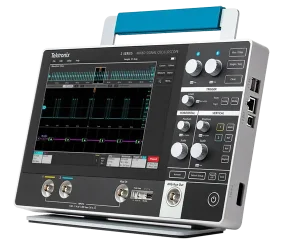
Empowering Semiconductor Design Fabs, Pangyo Silicon Valley AI R&D Centers, and Automotive BMS Engineering Clusters with Sub-Picoampere to Ampere Dynamic Current Characterization Instruments.
Send Inquiry NowDirect factory supply of flagship dynamic current profiling platforms and synchronized precision instrumentation deployed across Seoul and Gyeonggi R&D facilities.



From Pangyo Techno Valley’s fabless semiconductor ecosystem to the Giheung-Hwaseong-Pyeongtaek mega semiconductor cluster, precision current profiling has become a mission-critical engineering asset.
Over 200 semiconductor design houses in Pangyo Techno Valley require ultra-sensitive current waveform analysis down to 100 pA resolution to evaluate sleep-state leakage current and sub-millisecond dynamic awake current transitions in next-generation Neural Processing Units (NPUs) and RISC-V edge processors.
Engineers across Suwon, Hwaseong, and Icheon operate at the bleeding edge of sub-3nm gate-all-around (GAA) logic architectures and 3D V-NAND arrays. High-bandwidth current waveform analyzers pinpoint nanosecond parasitic current spikes, latch-up anomalies, and transient rail drop conditions during high-density multi-die write cycles.
Korean Tier-1 automotive suppliers in Seoul, Uiwang, and Incheon engineer Battery Management Systems (BMS), Traction Inverters, and ADAS ECUs. Device current waveform analyzers deliver uncompressed dynamic range verification to capture everything from sub-microampere automotive standby quiescent current to 100A switching pulses.
Traditional Source Measure Units (SMUs) offer sub-nanoampere precision but suffer from millisecond settling latencies, blinding engineers to rapid power transients. Conversely, conventional digital storage oscilloscopes (DSOs) provide gigahertz bandwidth but struggle with limited 8-bit dynamic range, high thermal noise floors, and excessive shunt-resistor burden voltages. A specialized Device Current Waveform Analyzer combines wide dynamic range transimpedance amplification (TIA) with 14-bit to 16-bit analog-to-digital digitizers, capturing up to 1 GSa/s real-time continuous current signatures across six decades of magnitude simultaneously.
How our current waveform measurement technology achieves high-bandwidth, high-dynamic-range current sensing without compromising DUT supply voltage integrity.
Traditional shunt-based current measurement introduces substantial voltage drop (burden voltage), often resetting sensitive microcontroller cores during high current draw. Our analyzer implements high-speed feedback Transimpedance Amplification (TIA) topologies and Rogowski-coupled active sensor heads, maintaining less than 15 mV insertion burden across 10 mA to 10 A current excursions.
Equipped with dual concurrent ADC engines per input channel, our architectures capture deep sleep states (sub-microampere resolution) and RF transmit burst current peaks (up to 30 Amperes) in an unbroken timeline. An automated hardware trigger engine switches gain ranges within 40 nanoseconds without losing waveform continuity or introducing switching distortion.
Introduction of customized gallium nitride (GaN) front-end preamplifiers, bringing noise ceilings down to 40 pA RMS while operating at 100 MHz sensor bandwidths for BLE 5.4 and ultra-wideband (UWB) tracking chips.
Synchronized optical IR pyrometric inputs mapped directly against localized current spikes, allowing semiconductor packaging labs in Pangyo to diagnose hot spots and electromigration hazards in real time.
Direct non-invasive magneto-optic sensor integration delivering galvanically isolated measurements capable of tracking 1000A/µs switching transients in 1200V SiC traction inverters without ground loop contamination.
On-chip neural acceleration identifying transient code-execution vulnerabilities, buffer overflows, and firmware side-channel leakage currents directly on the Seoul engineering test bench.
Tailored current waveform sensing frameworks meeting the stringent performance criteria of South Korea’s leading industrial manufacturing sectors.
Accelerate battery endurance validation for smart health rings, remote telemetry tags, and 5G RedCap IoT devices. Accurately measure microscopic standby states (sub-500 nA) and capture the sudden 200 mA surge of RF packet transmissions without waveform clipping or ground bounce.
Pacemakers, continuous glucose monitors (CGM), and neurostimulators demand multi-year operating lifetimes from miniature button cells. Our current waveform analyzers certify microscopic leakage budgets with traceable calibration for compliance with MFDS (Korea Ministry of Food and Drug Safety) standards.
Wide-bandgap (WBG) power devices operated by e-mobility power electronics innovators require sub-nanosecond rise-time resolution. Measure reverse recovery charge (Qrr), turn-on overshoot current spikes, and shoot-through anomalies in electric vehicle inverter stages under actual load conditions.
How our advanced Shenzhen and Southern China manufacturing infrastructure delivers premium instrument reliability, radical cost optimization, and shortened lead times for Korean enterprises.
Every analyzer produced in our ISO 9001 and ISO/IEC 17025 accredited production plants undergoes multi-tier component inspection. From military-spec low-noise FET operational amplifiers to multi-layer low-dielectric-loss PTFE circuit boards, our surface-mount (SMT) lines employ 3D Automated Optical Inspection (AOI) and automated X-ray inspection (AXI) to eliminate microscopic solder voids and parasitics.
Precision test instrumentation cannot drift in the field. Our manufacturing protocol subjects every device current waveform analyzer to a continuous 168-hour thermal cycling test chamber (-20°C to +65°C) under full dynamic excitation. This accelerates component stabilization, guaranteeing that zero-drift drift coefficients meet strict datasheet thresholds before export release.
While traditional Western instrument conglomerates quote lead times ranging from 16 to 36 weeks for specialized current analyzers, our direct factory-to-Seoul supply channel maintains strategic inventory reserves of core sensor heads, mainframe chassis, and calibration modules. Standard configurations dispatch within 72 hours, arriving at Incheon International Airport via direct air cargo in under 48 hours.
Korean procurement and lab managers communicate directly with instrument hardware engineers. We eliminate multiple distributor markups, providing bespoke fixture fabrication, API automation drivers (Python, LabVIEW, MATLAB), and direct firmware optimization for specific Korean DUT test procedures.
Full compliance assurance designed to streamline customs clearance, institutional procurement, and metrology audit approvals across South Korea.
All exported units conform strictly to South Korea’s EMC/EMI electromagnetic compatibility benchmarks and electrical safety standards under the National Radio Research Agency (RRA), ensuring zero regulatory hurdles for deployment in commercial labs or university facilities.
Units ship with factory calibration certificates traceable to KRISS (Korea Research Institute of Standards and Science) and NIST reference standards. Each unit includes detailed calibration data sheets documenting DC offset, gain linearity, and frequency response curves across every dynamic range setting.
Partnered with dedicated express cargo air-lines operating daily rotations between Shenzhen/Hong Kong and Incheon (ICN). We provide turnkey Delivered Duty Paid (DDP) trade terms, handling import customs declaration, customs tariff processing, and secure shock-absorbing crating directly to your lab door.
Key technical criteria for engineering procurement teams evaluating Device Current Waveform Analyzers against conventional test instruments.
Procuring direct from our China Industry 4.0 manufacturing hub offers significant strategic capital expenditure benefits:
Detailed answers regarding technical specifications, calibration protocols, delivery timelines, and after-sales service.
Traditional current clamps rely on Hall-effect sensors or magnetic cores, which exhibit high broadband noise floors (typically several milliamperes RMS) and large zero-point drift. They are incapable of measuring sub-microampere or nanoampere sleep currents. Our Device Current Waveform Analyzers utilize precision high-speed Transimpedance Amplifiers (TIA) and wide-bandwidth current shunt modules, achieving a noise floor as low as 100 pA with up to 200 MHz bandwidth, allowing simultaneous observation of both deep sleep states and peak active bursts.
Yes. Every analyzer features standard Gigabit Ethernet (LAN), USB 3.0 TMC, and optional GPIB interfaces. We supply native SCPI command documentation alongside pre-compiled LabVIEW VIs, Python libraries, and MATLAB scripts. Semiconductor test engineers in Pangyo or Hwaseong can integrate dynamic current logging into their automated wafer-probing or final validation test benches within hours.
All our instruments are covered by a standard 3-year factory warranty. We recommend a 12-month recalibration cycle. For Korean customers, calibration can be performed either by returning the sensor modules to our Shenzhen calibration laboratory via expedited 48-hour transit, or locally through any KOLAS-accredited calibration laboratory using our published calibration procedures and software alignment tools.
Burden voltage occurs when the voltage drop across a measurement shunt lowers the supply rail seen by the DUT, potentially triggering undervoltage lockouts (UVLO). Our proprietary active current probes maintain an active virtual ground condition through closed-loop feedback amplification, limiting insertion burden voltage to less than 15 mV even at maximum dynamic current peaks, ensuring DUT behavior remains identical to real-world battery-powered conditions.
We ship via direct premium air cargo (FedEx International Priority or DHL Express) departing directly from Shenzhen (SZX) or Hong Kong (HKG) straight to Incheon International Airport (ICN). For standard inventory items, transit time is typically 2 to 3 business days. We can provide complete DDP (Delivered Duty Paid) service, including all customs clearance formalities, import tax prepayments, and direct delivery to your Seoul or Gyeonggi-do premises.
Yes. Our engineering division regularly collaborates with semiconductor R&D teams to design custom high-frequency coaxial probe heads, triaxial low-noise adapters, and SMA interface breakout boards suitable for direct integration with wafer probers, environmental chambers, and customized socketed test boards.
Complete your lab capability with synchronized high-bandwidth oscilloscopes, calibration standards, logic analyzers, and precision parameter mainframes.