Choosing among China’s Frequency Counters manufacturers requires more than comparing prices or browsing attractive product pages. A reliable decision begins with the measurement task. Will the counter test crystal oscillators, RF generators, communication equipment, or laboratory references? The answer affects frequency range, resolution, input sensitivity, time-base stability, channel count, and signal compatibility. A unit displaying twelve digits may still perform poorly with a weak or noisy signal. That detail is easy to miss.
Lord Kelvin, a foundational measurement authority, said, “When you can measure what you are speaking about, and express it in numbers, you know something about it.” His words remain practical today. During supplier evaluation, buyers should request calibration records, phase-noise data, aging specifications, and real test reports. They should also examine connector quality, display readability, software support, and repair arrangements. A factory video can show assembly. It cannot prove long-term accuracy.
Experienced buyers often compare the same signal across several samples before approving a supplier. They check readings after warm-up, under changing temperatures, and with different input amplitudes. This process takes time. It may expose uncomfortable weaknesses. Some manufacturers offer excellent hardware but limited documentation. Others provide polished manuals while understating service response times. No supplier is perfect, and my own first shortlist would probably change after field testing. The strongest choice balances technical performance, traceable calibration, production consistency, communication, and total ownership cost. This guide explains how to assess China Frequency Counters manufacturers with evidence rather than assumptions.
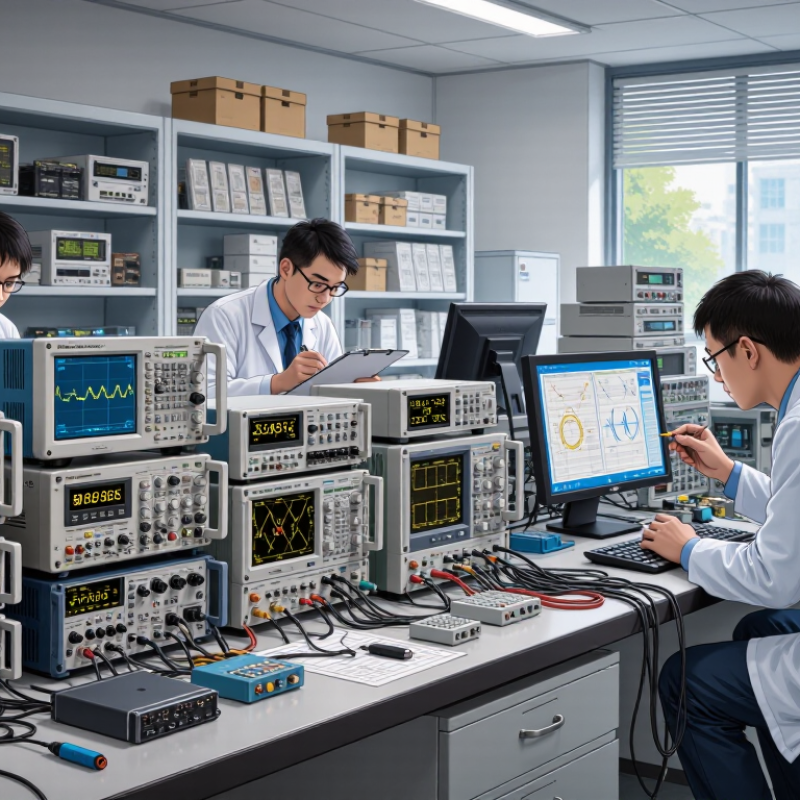
A frequency counter measures how often an electrical signal repeats each second. The result appears in hertz, such as 10 MHz or 2.4 GHz. In a workshop, technicians use these instruments to verify oscillators, clock signals, radio transmitters, and signal generators. A stable reading can reveal whether a circuit works within its specified limits.
Different applications require different performance. A laboratory may need high resolution, low time-base error, and external reference input. A production line often values fast measurement, simple controls, and durable connectors.
For wireless testing, input bandwidth, sensitivity, and protection against excessive power are critical. Measurement range matters too. A counter designed for low-frequency sensors may not handle microwave signals accurately.
When comparing manufacturers in China, buyers should examine calibration records, technical specifications, and support response times. Ask how the instrument is tested before shipment. Check whether the display remains steady when the input signal is weak or unstable.
Hands-on trials are useful, because published accuracy can depend on signal shape and measurement time. A common mistake is choosing the highest frequency range alone. It may offer impressive numbers, but poor resolution at practical settings.
I would also inspect the manual carefully. Missing connection examples can create avoidable errors during installation. Even experienced users sometimes overlook input impedance, triggering settings, or reference-clock quality.
Choosing among China’s top frequency counter manufacturers requires more than comparing maximum frequency. MarketsandMarkets’ 2024 Test and Measurement Equipment report estimates this market at over USD 30 billion, with steady growth through 2029. That growth increases supplier choices, but not necessarily measurement confidence. Check input sensitivity, resolution, gate-time options, phase-noise performance, and time-base stability. Ask for measured data, not only catalog values.
Calibration evidence matters. NIST Technical Note 1297 explains that measurement uncertainty must include repeatability, reference standards, and environmental effects. A capable manufacturer should provide traceable calibration certificates, uncertainty statements, and documented adjustment procedures. Review sample reports carefully. Vague wording is a warning. Run a pilot test using a stable reference source, a low-level signal, and several gate times. Record frequency error after warm-up.
Production control separates a reliable supplier from a promising one. Request serial-number traceability, inspection records, firmware revision history, and aging-test procedures. ISO 9001 certification can support process confidence, but it does not prove instrument accuracy. Factory audits and video demonstrations help, though they are imperfect substitutes for independent testing. I have found that response quality often reveals engineering maturity: technical staff should explain limits clearly, including inconvenient ones. Warranty duration, repair turnaround, spare-part availability, and remote diagnostic support also deserve written confirmation. The cheapest quotation may become expensive when calibration delays stop your test bench.
Choosing among China’s top frequency counter manufacturers requires more than comparing displayed digits. Accuracy should be tested against a traceable reference, not accepted from a brochure. NIST Technical Note 1297 explains that measurement uncertainty combines Type A and Type B components. Ask suppliers for uncertainty budgets, time-base stability, gate-time error, and calibration intervals. A counter showing twelve digits may still deliver weak results if its oscillator drifts. More digits are not always better.
Features should match the measurement task. Reciprocal counting improves resolution at low frequencies, while reciprocal and direct modes help verify fast signals. Check input bandwidth, sensitivity, trigger control, timestamp resolution, and external reference support. BIPM Circular T publishes UTC comparison data with nanosecond-scale offsets, showing why reference quality matters in demanding timing work. Certifications also deserve careful review. ISO/IEC 17025 calibration evidence is stronger than a generic quality statement, while IEC 61010-1 supports electrical measurement safety requirements. Reliability means documented thermal testing, connector durability, software updates, and repair response. I would inspect sample calibration records and repeat measurements across temperature changes. A polished interface is not proof. Supplier claims can be incomplete, and my own test plan may be imperfect. That is precisely why independent verification matters.
| Evaluation Dimension | Recommended Benchmark | Why It Matters | Evidence to Request from a Manufacturer | Risk if Overlooked |
|---|---|---|---|---|
| Frequency Accuracy | Choose a time-base specification that is at least 2–5 times better than the required measurement tolerance. Typical internal references range from approximately ±0.5–2 ppm for general-purpose instruments and approximately ±0.01–0.1 ppm for OCXO-equipped instruments. | The time base is the main reference used to determine frequency accuracy. A counter cannot provide better long-term accuracy than its reference and calibration status allow. | Time-base accuracy, aging rate, temperature stability, calibration interval, and the conditions under which the specification is guaranteed. | Measurements may appear stable while still having a significant absolute error, especially in telecommunications, RF, and laboratory applications. |
| Resolution and Gate Time | Look for selectable gate times, such as 1 ms, 10 ms, 100 ms, and 1 s, with higher resolution available at longer gate times. Reciprocal measurement methods are preferred for low-frequency and rapidly changing signals. | Longer gate times generally improve displayed resolution, while shorter gate times improve update speed. Reciprocal counting reduces the limitations of simple period counting at low frequencies. | Resolution versus gate-time table, measurement algorithm description, and examples for both low-frequency and high-frequency inputs. | A high digit count may be misleading if the instrument cannot maintain that resolution under the actual signal and gate-time conditions. |
| Input Frequency Range | Select a direct-input range that exceeds the highest expected frequency. General-purpose models commonly cover low frequency through tens or hundreds of megahertz; RF models may extend into several gigahertz or higher. | Operating near the upper limit can reduce sensitivity and increase susceptibility to waveform quality, connector, and cable losses. | Guaranteed frequency range, input sensitivity curve, maximum safe input level, and separate specifications for each input channel. | The counter may display unstable, incorrect, or intermittent readings when the signal is close to the stated maximum range. |
| Input Sensitivity and Signal Handling | Prefer a clearly specified sensitivity curve by frequency, with adjustable trigger level, input attenuation, coupling selection, and selectable impedance such as 50 Ω or 1 MΩ where appropriate. | Real-world signals often contain noise, harmonics, modulation, or low amplitude. Good input controls help prevent false counts and trigger instability. | Minimum input amplitude, trigger-level range, hysteresis, overload protection, input impedance, and maximum non-destructive voltage. | False readings, missed counts, input damage, or poor repeatability with non-sinusoidal signals. |
| Reference Input and Output | For system integration, consider an external 10 MHz reference input and a reference output. Confirm the required level, impedance, connector type, and locking or synchronization behavior. | A shared reference allows multiple instruments to maintain a common frequency standard and supports improved traceability in test systems. | Reference frequency, input power range, impedance, phase-noise information where relevant, warm-up time, and switching procedure. | Instruments may show offsets from one another, and synchronization may be unreliable during production or automated testing. |
| Measurement Functions | Useful functions may include frequency, period, frequency ratio, pulse width, duty cycle, totalize, event counting, and phase or time-interval measurement when required. | A broader function set can reduce the need for additional instruments, but only if each function has a clearly stated accuracy and input limitation. | Function-by-function specifications, operating modes, data logging capability, and sample or update rate. | The instrument may appear versatile but fail to meet the accuracy, bandwidth, or timing requirements of a specific application. |
| Connectivity and Automation | For automated test systems, prioritize USB or LAN connectivity, a documented command set, remote configuration, measurement-status queries, and data export formats. | Reliable remote control reduces operator error and supports repeatable production or laboratory workflows. | Communication manual, command examples, driver support, firmware update method, connection recovery behavior, and software compatibility. | Long integration time, inconsistent data collection, and difficult troubleshooting in automated environments. |
| Safety and EMC Compliance | Check applicability of IEC 61010-1 for measurement-equipment safety and IEC 61326-1 for electromagnetic compatibility. Required market markings may include CE or UKCA, depending on the destination market. | Compliance evidence helps address electrical safety, electromagnetic emissions, immunity, and market-entry requirements. | Declaration of conformity, test reports or certificates from recognized laboratories, product safety category, and applicable regional markings. | Import delays, compliance failures, unexpected interference, or increased risk to users and connected equipment. |
| Calibration and Traceability | Request a calibration certificate with measurement results, uncertainty, reference standards, date, and environmental conditions. For regulated work, use calibration performed by an ISO/IEC 17025-accredited laboratory. | Traceable calibration demonstrates how the instrument’s readings relate to recognized measurement standards. | Sample certificate, stated uncertainty, traceability chain, calibration points, recommended interval, and recalibration service process. | Results may not be defensible during audits, customer acceptance testing, or quality investigations. |
| Reliability and Environmental Performance | Review operating temperature, storage temperature, humidity limits, warm-up time, vibration requirements, cooling design, and documented production quality controls. | Time-base drift and electronic performance can change with temperature, humidity, vibration, and prolonged operation. | Environmental test information, burn-in or final-test records, failure-rate data when available, serial-number traceability, and spare-parts policy. | Unexpected downtime, unstable measurements, shortened service life, and higher total ownership cost. |
| After-Sales Support | Evaluate warranty duration, repair turnaround, firmware support, technical documentation, remote troubleshooting, replacement availability, and local service capability. | Service quality directly affects instrument availability and the long-term value of the purchase. | Written warranty terms, service-level targets, escalation contacts, repair process, software lifecycle policy, and customer references for comparable applications. | A low purchase price may be offset by extended downtime, unavailable parts, or expensive out-of-warranty repairs. |
| Acceptance Testing | Before volume purchase, test representative units using a calibrated reference source across the intended frequency range, input levels, gate times, and environmental conditions. | A practical acceptance test confirms that published specifications match the intended application and production environment. | Agreed test procedure, pass/fail limits, raw measurement data, serial-number records, and corrective-action process. | Performance differences may remain undiscovered until after installation or customer delivery. |
Note: The benchmarks above are general purchasing guidelines rather than specifications for any particular company, model, or brand. Always verify the latest manufacturer datasheet and compliance documentation before purchasing.
When evaluating China’s top frequency counter manufacturers, start with factory capability, not catalog claims. Ask how many units the line can test each month. More importantly, inspect how they control variation. A serious facility uses automated fixtures, calibrated reference sources, burn-in stations, and final inspection records. Request sample data for frequency accuracy, gate-time stability, input sensitivity, and measurement repeatability. Check whether calibration equipment is traceable to recognized national or international standards. Production capacity means more than assembly speed. It includes component sourcing, operator training, firmware control, and quality during demand peaks. A fast delivery promise may hide weak testing.
Customization should begin with the measurement problem. Define input amplitude, frequency range, connector type, display needs, communication protocol, enclosure size, and operating temperature. Some suppliers can modify firmware, add an external reference input, or support synchronized measurements. Others only change labels and panels. Ask for an engineering change record, prototype schedule, validation plan, and ownership of test data. A useful trial uses real signals, not only a clean laboratory source. Include low-level inputs, unstable signals, and long-duration operation. This exposes noise, overflow behavior, and missed readings. Higher speed is not always higher value.
Technical support often decides whether a customized counter succeeds after shipment. Evaluate response time, diagnostic tools, spare-part policy, software update control, and remote troubleshooting ability. Request a clear manual with wiring diagrams and error codes. Confirm who handles calibration questions and field failures. One overlooked detail can stop a production line. I would ask for a small pilot order before volume purchasing. It may cost more initially, but it reveals communication gaps and unrealistic specifications. The uncomfortable lesson is that supplier selection should test cooperation, not just the instrument.
Choosing a frequency counter supplier in China requires more than comparing the lowest quotation. A practical price review should include the meter, calibration, packaging, shipping, and after-sales support. Ask whether the quoted unit uses the same specifications as the sample. A cheap offer may exclude testing fees or require a high minimum order. That detail can change the real cost.
Request samples before placing a production order. Test the counter with a trusted signal source across its full frequency range. Check reading stability, gate-time settings, display response, input sensitivity, and protection against accidental overload. Record each result with the sample’s serial number. Test again after several hours of operation. Small differences matter.
A supplier should provide clear technical documents, calibration records, inspection procedures, and production lead times. If possible, request photographs of the testing area and a sample inspection report. A sample can pass while later production drifts. Do not rely on one successful reading. Require pre-shipment checks using agreed acceptance limits. A third-party inspection may add cost, but it can reveal loose connectors, unstable buttons, or inconsistent displays. I have found that supplier communication is also a quality signal. Vague answers deserve another question. No supplier is perfect, and specifications sometimes need revision after testing. Leave room for that correction before approving mass production.
It measures how many times an electrical signal repeats each second. Results appear in hertz, such as 10 MHz or 2.4 GHz.
Technicians use them to check oscillators, clock signals, transmitters, and signal generators. A stable reading can reveal circuit problems.
Compare frequency range, input sensitivity, resolution, gate-time options, bandwidth, and time-base stability. Maximum frequency alone is not enough.
A counter designed for low-frequency sensors may not measure microwave signals accurately. Choose a range matching your actual signals.
Request traceable calibration certificates, uncertainty statements, and adjustment records. Review sample reports carefully. Vague wording needs clarification.
Use a trusted signal source across the expected frequency range. Check stability, display response, sensitivity, gate times, and overload protection.
Ask for serial-number traceability, inspection records, firmware history, and aging-test procedures. These records make later problems easier to investigate.
Include the instrument, calibration, packaging, shipping, testing, and after-sales support. A low quotation may exclude important charges.
No. Process certification can support confidence, but it does not prove every instrument is accurate. Independent testing remains useful.
Confirm warranty length, repair time, spare-part availability, remote support, and calibration service. Delays can stop a test bench.
Do not choose the highest frequency range alone. Check input impedance, triggering, reference quality, and practical resolution.
One reading proves little. Test after warm-up and several operating hours. A sample may pass while later units drift.
Choosing the right Chinese manufacturer for Frequency Counters requires a clear understanding of how these instruments work and where they are used, including laboratories, telecommunications, electronics testing, education, and industrial maintenance. Buyers should compare measurement accuracy, frequency range, resolution, display functions, data interfaces, certifications, product stability, and long-term reliability. A trustworthy manufacturer should provide transparent technical specifications, consistent quality control, and products that match the intended application.
It is also important to evaluate production capacity, engineering expertise, customization options, delivery capability, and after-sales technical support. Before making a final decision, buyers can request samples, review inspection procedures, verify certifications, and assess communication efficiency. Pricing should be considered together with product performance, warranty terms, spare parts availability, and total ownership cost rather than viewed as the only deciding factor. By combining technical evaluation, factory assessment, sample testing, and quality checks, buyers can select a dependable supplier that offers suitable Frequency Counters and stable long-term cooperation.